Showing posts with label Sunflower Seeds. Show all posts

Friday, October 27, 2017

GERMAN SUNFLOWER SEED SQUARES - HEARTY SOURDOUGH ROLLS WITH RYE & SEEDS


Hier geht's zur deutschen Version dieses Posts


Whenever I'm visiting my hometown Hamburg, I check out new bakeries. Two years ago I noticed people lining up in front of Bäckerei Jochen Gaues, in Eppendorf quarter, where my Mom lives around the corner.

Taking this as a good omen, I joined the waiting line. The shelves full of loaves and rolls looked promising, all with fairly dark crusts - boldly baked, as Ken Forkish ("Flour, Water, Salt and Yeast') would call it. A paradise for crust lovers!

Like Forkish, Jochen Gaues is a purist baker, his breads are made with flour, water, salt and yeast. No dough enhancers, no preservatives, no artificial flavoring. Only sourdough and passion for his craft. And he shared his recipes in a beautiful baking book, too.

His sunflower seed rolls are hearty, crusty and delicious. (I tweaked the recipe a bit, of course, as I always do). The crumb is rather light and more airy than chewy. You can enjoy them with cold cuts, German meat salad, honey or jam. 
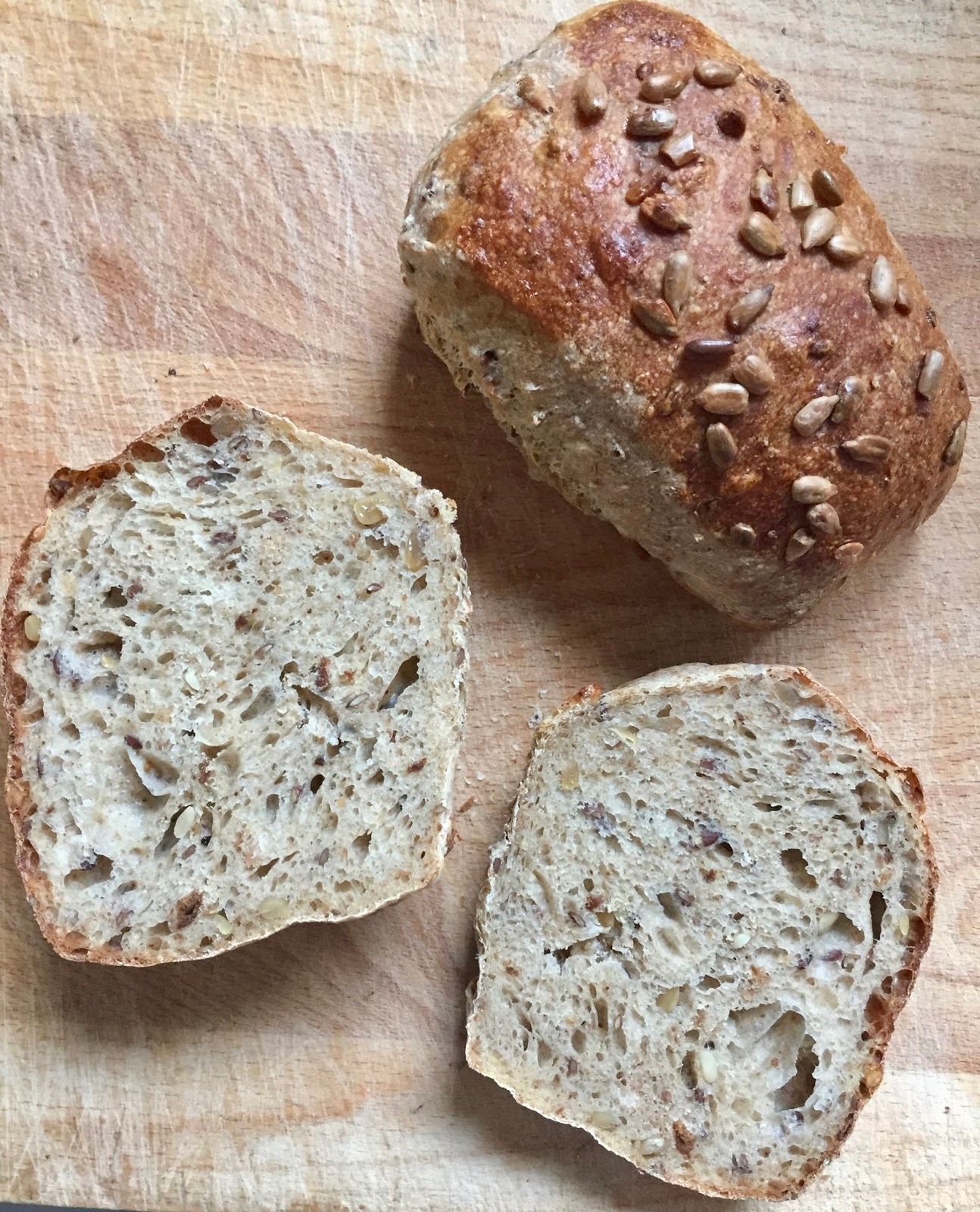
The rolls have a thin, crisp crust and a somewhat airy crumb


SUNFLOWER SEED SQUARES  (adapted from Jochen Gaues' "Brot")
(8 square rolls)

Starter
  10 g/0.3 oz recently refreshed rye mother starter (100%)
  10 g/0.4 oz water, lukewarm
  10 g/0.4 oz rye flour

Soaker
  25 g/0.9 oz cracked rye
  25 g/0.9 oz flaxseed
  50 g/1.8 oz water 

Final dough
  30 g/1.1 oz starter (all)
367 g/12.9 oz water (95°F/35ºC)
    3 g/0.1 oz instant yeast
475 g/15.8 oz bread flour
  50 g/1.8 oz old sourdough bread, ground and toasted
  25 g/0.9 oz medium rye flour
  25 g/0.9 oz sunflower seeds, toasted
  14 g/0.5 oz sugar
  14 g/0.5 oz salt

egg white, mixed with a little bit of water, for brushing
sunflower seeds, for topping

Seed soaker and rye starter

DAY 1
In the morning, mix starter ingredients in small bowl. Leave, covered, at room temperature for 4 - 6 hours, or until it passes the float test (a teaspoonful should float in water).

In second small bowl, stir together soaker ingredients. (This extra step is not absolutely necessary, but hard ingredients like rye chops and flax seeds benefit from longer soaking.)

In the afternoon, mix final dough at low speed until all flour is hydrated, 1 - 2 minutes. Let dough rest 5 minutes, then knead at medium-low speed for 6 minutes. Dough will be soft and sticky, but pull back from sides of bowl. 

Dough will be sticky, but pull back from sides of bowl

Transfer dough to lightly oiled work surface. With oiled hands, pat and pull it into a rough square. Fold dough from top and bottom in thirds, like a business letter, then the same way from both sides.

Pat and pull dough into a square...
...then fold in thirds, top down, and bottom up...
...like a business letter.
Repeat folding from both sides...
... until you have a neat package

Cover dough package with the empty mixing bowl (if necessary, re-oil works bench). Let it rest for 10 minutes.

Repeat stretching and folding the dough 3 more times, at 10 minute intervals. It will gain strength and starting to resist. Place dough in oiled container, cover, and refrigerate overnight (a square container helps with shaping later).

Before...
...and after fermentation: it has doubled in volume

DAY 2
Remove dough from fridge 2 hours before using. It should have doubled in volume.

Preheat oven to 475ºF/240ºC (no steam).

Place dough on a lightly floured work surface, sprinkle with a little flour (it will still be a bit sticky), and gently pull and pat it into a rectangle, then cut into 8 square pieces. Place squares on parchment lined (or perforated) baking sheet.

The rolls are cut, not shaped

Brush rolls with egg white, then sprinkle each with sunflower seeds, gently pressing them down to stick. Cover, and proof for about 25 - 30 minutes, or until a finger-poked dimple remains visible. (Since the dough is cut, not shaped, it is puffy and doesn't need to rise much more - basically only until the oven is hot).

Ready for the oven

Bake rolls for about 20 minutes (rotating them halfway through), or until they are a dark golden brown, and register at least 200ºF/93ºC on an instant read thermometer.

Freshly baked Sunflower Seed Squares

BreadStorm users (also of the free version) can download the formula here.


Monday, June 13, 2016

FRIESISCHES SCHWARZBROT - A HEARTY RYE FROM THE NORTH SEA COAST

When I started baking breads for A&B Naturals, I searched online for some interesting rye breads. A recipe that really intrigued me was made with an intermediate dough, with a batter-like consistency, and just poured into a loaf pan - no shaping involved!

At The Fresh Loaf, my Frisian Rye post sparked a bit of a controversy - a Dutch user protested this were not a "real fries roggebrood": a pumpernickel-type bread, dark, and very slowly baked.

North Frisian Islands

But the Frisian region stretches along the North Sea coast from the Netherlands to Germany and up to Denmark, and there is really no such thing as ONE authentic Frisian Rye.

A quick search on Google shows several different recipes, all with different amounts of rye, wheat, seeds, and what not. I was never able to find the original recipe again, but the guy who had posted it said he was from Frisia - so he should know!

Whether real authentic or not - this Friesisches Schwarzbrot tastes great! Over the years I tweaked the formula quite a bit to achieve a nice, thin crust and satisfying crumb.


                                               Amrum - my favorite North Frisian island

The North Sea coast is lovely, dotted with islands, with white sand beaches and dunes, and definitely worth a trip - whether on the Dutch, German or Danish side. Close to Hamburg, this was a popular destination for our family vacations.

Fortunately, it's not sooo different from Maine, so I won't get homesick!

A typical sea coast resident - whether in Germany or in Maine!

FRIESISCHES SCHWARZBROT - FRISIAN RYE

Starter:
100 g rye meal
  26 g whole wheat or rye mother starter
200 g water, lukewarm

Intermediate Dough:
     all starter
100 g rye meal
100 g whole wheat flour
150 g water, lukewarm

Final Dough:
     all intermediate dough
100 g whole wheat flour
    6 g salt
  10 g honey
    8 g molasses
  25 g flax seeds
  25 g sesame seeds
  25 g sunflower seeds, toasted
  50 g water, lukewarm (or more, as needed)
sunflower seeds for topping


Sunflower seeds, sesame and flax seeds for a nice crunch

DAY 1
Stir together all starter ingredients in medium bowl. Cover, and leave at room temperature to ferment overnight.

The intermediate dough is very liquid

DAY 2
In the morning, using a large spoon or Danish dough whisk, mix together all ingredients for intermediate dough until well combined. Cover, and leave at room temperature for 6-8 hours, until its visibly risen and puffed.

Wow - hyperactive intermediate dough!

In small bowl, soak flax seeds in the water for final dough (longer soaking makes them better digestible).

In the evening, using a large spoon, dough whisk (or mixer with paddle attachment on low speed), mix together all final dough ingredients for a few minutes, until well combined - dough will have the consistency of thick pancake batter.

This is what the dough looks like after mixing

Fill dough up to 3/4 in lightly oiled medium sandwich loaf pan (9-inch), smooth with wet rubber spatula, and sprinkle with sunflower seeds. Cover pan with aluminum foil (you will use it as cover for baking, later) and refrigerate overnight.

Ready for a cold night in the fridge

DAY 3
Remove dough from refrigerator 2 hours before baking. The bread will have risen a bit, but not much.

Preheat oven to 450ºF/230ºC.

The dough is puffed, but has not risen much

Place bread (covered with foil) in oven, reduce temperature to 425ºF/220ºC, and bake for 15 minutes. Remove aluminum foil and bake for another 40 minutes (rotate180 degrees after 20 minutes, if bread browns uneven). Internal temperature should be at least 200ºF/93ºC.

Freshly baked Frisian Ryes

Remove bread from pan. Mist bread with water while hot (optional - this softens the crust a bit), and let it cool on wire rack.

To avoid a gooey mess on your bread knife, be patient and wait at least for 12 hours to cut into your bread - and it will have developed its full aroma, too!

Even if it's hard to resist - wait at least 12 hours before slicing!

BreadStorm users (also of the free version) can download the formula here.


Friday, October 4, 2013

CECILIENHOF VOLLKORNBROT - WHEN TASTE MEETS TRADITION


One of the best breads I ever made
 Hier geht's zur deutschen Version dieses Posts


During our recent trip to Germany we spent a few days in Potsdam, to visit Frederick the Great's Sanssouci. We stayed at Schlosshotel Cecilienhof, a wonderful hotel right inside another historic site, Cecilienhof Palace.

Cecilienhof Palace in Potsdam, a UNESCO world heritage site

Built 1917 by Crown Prince Wilhelm of Prussia for his wife Cecilie, Duchess of Mecklenburg, this Tudor revival style palace was also the place where these three jolly old guys met:

Churchill, Truman and Stalin at the Potsdam Conference

To honor the history and importance of this heritage, the hotel came up with the idea to create a special bread for the guests' breakfast buffet: an ancient grain sourdough, with a lot of different grains and seeds.

Bread buffet at Schlosshotel Cecilienhof

Multigrain bread served at Schlosshotel Cecilienhof
To educate their guests, the hotel had placed a little brochure on the table, with informations about the bread: "Taste meets Tradition", including a list of the ingredients:

List of ingredients of Cecilienhof Ancient Rye Bread
Rye meal
Water
Sunflower seeds
Ancient wheat meal: emmer and einkorn
Wheat flour (white or medium, not whole wheat)
Rolled spelt
Chestnut flour
Rolled oats
Barley meal
Barley malt extract
Vital wheat gluten
Rolled barley
Flaxseed
Steel cut oats
Spelt flour
Potato flakes
Sea salt
Vegetable fat (shortening)
Whole spelt sourdough
Table salt
Yeast

Unfortunately they didn't supply the bakers' percentage!

Though I'm not the greatest vollkornbrot fan (having been force fed as a child) I really liked the bread, and was quite intrigued by the impressive list of ingredients.

Wild Rice Sourdough - The Bread That Ended The Cold War

In my repertoire I had already one remarkable bread associated with an important historic event: Wild Rice Sourdough - The Bread That Ended The Cold War. Wouldn't it be great to add another one?

I couldn't stop thinking about it, and deemed it a challenge worthy of my talented fellow bakers at The Fresh Loaf. And they rose to the occasion!

Janet's bread


Janet Cook from Colorado bakes breads for the joy of it, though she can't eat them herself.

She modeled her Cecilienhof rye look-alike after Russian rye or Borodinsky bread (her formula and photos are in the comments.)


Dabrownman's version
Prolific multigrain/many seed baker dabrownman from Arizona likes to taunt his audience with food porn and breath taking sunrise photos.

Helped by his no-nonsense, paws-on apprentice Lucy he created this version.


Brian's loaf
Brian (Skibum) from Canada felt encouraged to go over to the "dark side" with his first ever rye vollkornbrot.

A beautiful thing to behold!


Jürgen's take on Cecilienhof bread


Jürgen Krauss (Germany/UK) baked his loaf slowly over 12 hours, like a pumpernickel.

He praised the deep flavors and great versatility of his Cecilienhof challenge bread.  


Ian's nutty bread
Ian (isand66), from New York, gave the bread his personal touch by adding poppy and sesame seeds, pecans and "a bunch of more whole grains".


Inspired by all this activity I sat down with my BreadStorm program to create my own formula. Except for the emmer, I had all the ingredients from the list in my pantry.

Two of my breads would be my base, Friesisches Schwarzbrot (Friesian Rye) and
Rheinisches Schwarzbrot (Rhineland Rye).

Friesisches Schwarzbrot

Using an intermediate dough, like the Friesian Rye (thus eliminating the need for additional yeast,) and baking my loaf like Rhineland Rye seemed a good way to do it.

Rheinisches Schwarzbrot

I also omitted the vital wheat gluten, neither wanting to make quick process with my bread, nor being so anxious that I needed a "safety net".

The bread turned out to be one of the best loaves I ever made, we absolutely LOVED it! Whether it was the complexity of the ingredients, or just an optimal process to develop and marry the different flavors I can't say.

We had it with aged provolone cheese and blackforest ham, and it also tasted wonderful with honey.

Much as I enjoyed the original in its historic ambiance - my bread can at least hold a candle to it. The best of all husbands claims its even better (what a pity you can't see my oh so modest smile!)

Here you see my baker's formula in % (BreadStorm users can download it here)


CECILIENHOF VOLLKORNBROT

Starter
26 g whole wheat mother starter
100 g rye meal
200 g water, lukewarm 

Intermediate dough
all starter
50 g rye meal (I used here a coarser grind)
13 whole wheat flour
45 g rolled spelt
30 g rolled oats
20 g barley meal
10 g spelt flour
11 g rolled barley
12 g flax seed
9 g steel-cut oats
150 g water, lukewarm

Final dough
all intermediate dough
37 g whole wheat
35 g einkorn flour
35 g farro flour
40 g chestnut flour
8 g salt
20 g barley malt syrup
120 g sunflower seeds, toasted
7 g potato flakes
7 g sunflower seed oil
50 g water

Very liquid starter

DAY 1:
Mix all ingredients for the starter, cover and leave at room temperature for 12 - 24 hours.

DAY 2:
In the morning, mix together all ingredients for intermediate dough. Cover, and leave at room temperature.

Intermediate dough

In the evening, mix together all ingredients for final dough, adjusting with more water, if necessary, to make a very sticky dough.

Fill dough into a (9-inch) sandwich loaf pan (up to 3/4), smooth top with wet hands, and sprinkle it with sunflower seeds. Mist with oil spray, cover pan with aluminum foil, and refrigerate dough overnight.

Final dough in the pan - no shaping necessary

DAY 3:
Remove bread from refrigerator 2 hours before baking, to come to room temperature.

Preheat oven to 450ºF/230ºC.

Bake bread (loosely covered with aluminum foil) at 425ºF/220ºC for 15 min. Remove foil, and bake for 40 minutes more, or until it registers at least 200ºF/93º.

Un-pan loaf onto wire rack, then mist with water, and let it cool completely before cutting.

Cecilienhof Vollkornbrot also freezes well - when it is completely cooled, wrap it in plastic and place in a ZipLock bag.

Crown Princess Cecilie, Duchess of Mecklenburg

Submitted to YeastSpotting

Submitted to Panissimo:  Bread & Companatico
                                        Indovina chi viene a cena                                             
This month's Panissimo is hosted by Simona Briciole


Tuesday, September 24, 2013

SPROUTED GRAIN BREAD

Hier geht's zur deutschen Version dieses Posts


A while ago I saw a bread recipe that intrigued me. Not only had it a lot of grains, but, also, three different kinds of sprouts: wheat, lentils and quinoa.

To make a sprouted grain bread you have to plan ahead, because it takes about 2-3 days until the first little white tips show up on the soaked grains.

Wheat, lentils and quinoa are beginning to sprout

Once sprouted, the grains are pureed into a smooth paste that, together with toasted sunflower-, pumpkin- and sesame seeds, gives this interesting bread its unique taste.

I changed the original recipe, created by "America's Test Kitchen", quite a bit. Though I don't mind a hint of sweetness, I don't like "falling into the honey jar" (as the Germans say), and 1/3 cup of honey in the dough seems a lot, even with the potentially bitter bran and fibers of the whole grains.

Pumpkin-, sunflower- and sesame seeds (I used black sesame)
Instead of long kneading I prefer stretching and folding the dough, combined with an overnight rest in the fridge.

This slow fermentation ensures good digestibility, and the aroma of the bread has more time to develop.

And, as an additional benefit, you need less yeast.

I was a bit leery whether you would taste the lentils (as I had experienced with some gluten free pastry made with bean meal.)

The bread looked so appetizing, when it came out of the oven, that we could hardly wait until it had cooled down enough to be cut.

Fortunately my fears proved to be unfounded, my sprouted grain bread was as tasty as it looked. No harsh legume aroma met our taste buds, the lentils blended harmoniously with the other ingredients.

The bread was also good for toasting, and we liked it especially with butter and honey.


SPROUTED GRAIN BREAD   (adapted from Cook's Illustrated)

Sprouted Grains
140 g/4.9 oz wheat berries     (3/4 cup)
  43 g/1.5 oz quinoa                (1/4 cup)
  41 g/1.4 oz brown lentils      (1/4 cup)
    2 cups cold water

Dough
 ½ cup warm water                 (110ºF/43ºC)
 42 g/1.5 oz honey                  (2 tbsp)
 36 g/1.3 oz sunflower seeds  (1/4 cup)
 20 g/0.7 oz pumpkin seeds    (2 tbsp)
 17 g/0.6 oz sesame seeds       (2 tbsp)
274 g/9.7 oz bread flour
    4 g/0.14 oz instant yeast
    7 g/0.25 oz salt                    (1 1/2 tsp)
1 egg white, mixed with 1 tsp. water, for brushing


DAY 1:
For the sprouted grains, combine wheat berries, quinoa, lentils and water in large bowl, cover, and let soak at room temperature for at least 12 hours (and up to 24 hours.)

DAY 2-3:
Drain grains through fine-mesh strainer (caution: if the mesh is not fine enough the quinoa seeds will fall through), then return them to the bowl.

Cover, and leave at room temperature, rinsing and draining grains daily, until small sprouts appear on each type of grain. (At this point, they can be patted dry and refrigerated for up to 1 week.)

  Puree sprouted grains in food processor to a sticky paste

DAY 3-4:
Process sprouted grains in food processor to a smooth, sticky paste, 2-3 minutes.

Combine seeds in small bowl. Toast 45 g/6 tbsp. of the seeds (reserve remaining seeds for topping.) Whisk water and honey together in measuring cup. 

Combine sprouted grains, bread flour, yeast, and salt in bowl of stand mixer with dough hook. Add water/honey mixture, while mixing on low speed for 1-2 minutes, until dough comes together and all flour is hydrated. Let it rest for 5 minutes.

Knead dough on medium-low speed for 6 minutes, slowly adding toasted seeds until dough is smooth, elastic, but still a bit sticky (dough should clear sides of bowl, but stick a bit to bottom.)

Transfer dough to lightly oiled or wet counter. With oiled or wet hands, stretch into a rough square, and fold from top and bottom in thirds, like business letter. Then fold from both sides. Gather dough into a ball, and place, seam side down, into lightly oiled bowl. Cover, and let it rest for 10 minutes.

After the last fold refrigerate the dough overnight

Repeat this stretching and folding 3 times in 10 minute intervals. After the last fold, place dough in refrigerator for a slow overnight rise.


DAY 4-5:
Remove dough from refrigerator, and let sit at room temperature for 2 hours, or until almost doubled in size.

Over night the dough has almost doubled

Preheat oven to 425ºF/220ºC. Line baking sheet with parchment paper.

Shape dough into a round, and place it, seam side down on prepared baking sheet. Brush bread with egg wash and sprinkle with reserved seeds. (No slashing needed.)

Sprinkled with seeds the bread looks pretty good already

Cover, and let bread rise for about 45 - 60 minutes, until nearly grown to double its original size (finger probe: a dimple made with a finger should not close again).

Bake bread at 350ºF/175ºC for 20 minutes, rotate 180 degrees, and continue baking for another 20-30 minutes, until it is golden brown, sounds hollow when thumped on the bottom, and registers 210ºF/99ºC on an instant read thermometer.

Let bread cool on wire rack.

Tastes good as BLT-sandwich, too!


Submitted to YeastSpotting
Submitted to Panissimo:  Bread & Companatico
                                        Indovina chi viene a cena