Showing posts with label Sesame. Show all posts

Sunday, August 20, 2017

SOLAR ECLIPSE BREAD - A CRUSTY SESAME LOAF FOR A RARE EVENT

Hier geht's zur deutschen Version dieses Posts


This month Mini Oven challenged fellow Fresh Loafers to create a special bread to commemorate the upcoming total eclipse of the sun. Spurred by astronomic ambitions I began to ponder how to go about this.

Just a new bread? Where was the connection to the total eclipse?

A two-toned dough? Once I baked a marbled rye bread and found its taste rather underwhelming.

Squid ink as a black dye? Not my cup of tea!

So it had to be a two-toned decoration. Black and white sesame seeds are in my pantry. Only a suitable recipe was missing. It couldn't be a loaf whose oven-spring would tear and destroy any decorative topping.

The answer was a flat bread that would spread more than rise.

I found a good starting point in Austrian baker Dietmar Kappl's Fladenbrot, tweaking it to suit my needs: with a long, cold bulk fermentation and the introduction of a little whole grain flour (I tried it with rye and emmer - both tasted great).

To emulate the eclipse I needed a ring-shaped utensil to press the outline of the moon into the dough. A large yogurt tub had just the right diameter (11.5 cm/4.5 inches).

We were so happy with my crusty, nutty flat bread that I baked it again, two days later, for my customers at A&B Naturals.

Baked again for my customers: Solar Eclipse Bread

SOLAR ECLIPSE BREAD  (adapted from Dietmar Kappl/homebaking.at)
(3 small breads, à 300 g)

Starter
25 g bread flour
25 g emmer flour (or other whole grain flour of your choice)
50 g water (lukewarm)
10 g recently refreshed and active starter (100% hydration)

Final Dough
110 g starter (all)
400 g bread flour
50 g emmer flour (or other whole grain flour)
325 g water, lukewarm
15 g olive oil
10 g salt
1.5 g instant yeast (or 3 g active dry yeast)

Decoration
black and white sesame seeds (or use poppy seeds instead of black sesame)

Specal tool: glass or plastic container with approx. 11-12-cm/4.5-inch diameter, like a large, empty yogurt tub (to imprint the outline of the moon).

DAY 1
In the morning: mix all starter ingredients. Cover, and leave for 4-6 hours at room temperature, or until a few tiny bubbles appear on the surface, and a teaspoon of dough floats in water (float test).

The Ankarsrum makes short work of kneading the dough

For the final dough, mix all ingredients about 1 minute at low speed until all flour is hydrated. Knead 1 minute at medium speed, let rest for 10 minutes (autolyse), then resume kneading for about 3-4 minutes, until dough pulls somewhat back from sides of bowl (or, for the Ankarsrum, from roller) (dough will be sticky).
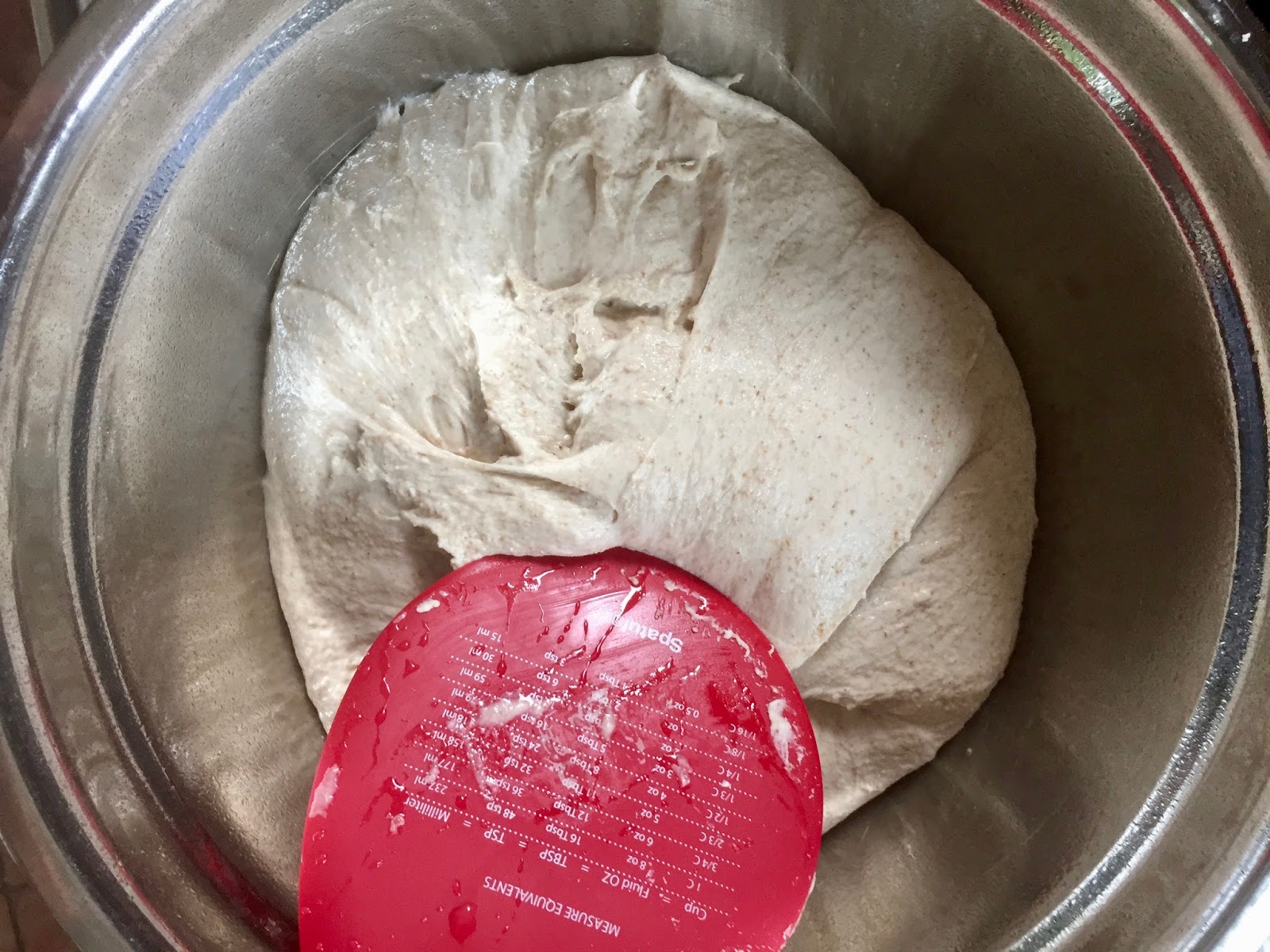
Using wet bowl scraper, fold dough all around from sides to the center

Transfer dough to a lightly oiled bowl. Using wet (or oiled) bowl scraper, fold dough all around from sides of bowl to the center (about 8x).

Let dough rest for 10 minutes, then repeat the folding process 2-3 times at 10-minute intervals, until dough has developed enough strength and shows resistance to folding. It will still be a little sticky.

Cover bowl tightly with plastic wrap and place in refrigerator overnight (no need to de-chill).

After 2 sets of folds the dough looks quite smooth already

DAY 2
Preheat oven to 475ºF/250ºC, (including steaming device). Adjust rack to middle position.

Place cold dough (it will still be sticky) on lightly floured work surface. Dust top with a little flour, and divide into 3 equal sized pieces (about 304 g). Shape into rounds.

Divide dough in 3 equal pieces and shape into rounds

Place breads, seam-side down, on parchment lined baking sheet. Mist with oil (or mist plastic foil cover with oil) and cover with plastic wrap. Let rest for 45 minutes, or until they are a bit puffed and a dimple, poked with your finger into the dough, remains visible. 

The moon outline must be deeply imprinted into the dough

Lightly oil the rim of the glass or plastic tub. Press down deep (almost to the bottom) into the dough (breads will spread and flatten.)

I tried to create different "stages of the solar eclipse"

Mist breads with water. Using a teaspoon, carefully sprinkle with black sesame (moon shadow) and white sesame (sun.)

Bake breads, with steam,  for 10 minutes. Remove steam pan, and reduce temperature to 450ºF/230ºC. Bake for another 10 - 13 minutes, or until breads are golden brown and register at least 200ºF/93ºC.

Let breads cool on a wire rack. (When cooled, they can be frozen, wrapped individually in foil, and placed in a freezer bag. Let come to room temperature, mist with water and re-crisp in the oven at 375ºF/190ºC).

Baked solar eclipse!

BreadStorm users (also of the free version) can download the formula here:

And this is the perfect music for a Total Eclipse:

Thursday, October 16, 2014

WORLD BREAD DAY 2014 - PANE SICILIANO

Hier geht's zur deutschen Version dieses Posts


Zorra hosts the annual World Bread Day "to honor our daily bread" and show that baking bread can be easier than you think, and also great fun.

World Bread Day 2014 (submit your loaf on October 16, 2014)My contribution - I participate for the first time - is one of my all-time favorites: Pane Siciliano from Peter Reinhart's The Bread Baker's Apprentice.

One of the few all-white breads in my repertoire, I bake this often, my customers love it, and I always make some extra loaves for us.

Many Mediterranean countries have a tradition of sesame breads, like ring-shaped Turkish Simit - another favorite. Pane Siciliano, from Sicily, is rolled into an attractive S-shape.

Made with semolina flour, it has an extraordinary good taste, due to a preferment and a long rest overnight in the fridge.

The sesame topping provides an extra-nice crunch.

Pane Siciliano is no quick bread - plan ahead, start with the pâte fermentée 2 days before you plan to bake.

Fluffy inside and crunchy outside

BreadStorm user (also of the free version) can download the formula.

PANE SICILIANO  (adapted from Peter Reinhart's The Bread Baker's Apprentice)
(4 small breads) 

Pâte Fermentée
142 g/5 oz all-purpose flour
142 g/5 oz bread flour
5 g/0.18 oz salt
1 g/0.4 oz instant yeast
177 g/6.24 oz water

Final Dough
454 g/16 oz pâte fermentée (all)
227 g/8 oz semolina flour
227 g/8 oz bread flour
9 g/0.3 oz salt
3 g/0.1 oz instant yeast
29 g/1 oz olive oil
22 g/0.75 oz honey
235 g/8.3 oz water
10 g sesame seeds, for topping

DAY 1
For the pâte fermentée: mix all ingredients at low speed for 1 minute, until all flour is hydrated, then knead on medium speed for 4 minutes (the dough should be tacky, but not sticky, adjust with a bit more water or flour, if necessary (DDT: 77-81ºF/25-27ºC).

Pâte fermentée

Place dough in a lightly oiled bowl, roll it around to coat with oil, cover, and leave for 1 hour at room temperature, or until it has grown 1 1/2 times. Degas it lightly, and refrigerate it overnight (or up to 3 days).

DAY 2
Remove the pâte fermentée from the refrigerator 2 hours before using, to warm up. For an easier distribution in the final dough, cut it in several smaller pieces.

For an easier distribution in the dough, cut pâte fermentée in small pieces

Knead all dough ingredients at low speed for 1-2 minutes, until all flour is hydrated, then at medium speed for 6 minutes (DDT: 77-81ºF/25-27ºC). Like with baguettes, the dough should be supple, smooth, tacky, but not sticky. Adjust with a bit more water, if necessary (Beware: if the dough is too soft, the coils will be less distinct!)

Fermentation in square containers makes the shaping easier

Place the dough in an oiled container, turn around to coat with oil, cover, and leave it at room temperature for about 2 hours, or until it has doubled in size. (I like to divide the dough in 2 portions before the bulk fermentation.)

Line a baking sheet with parchment paper and sprinkle it with semolina flour.


Divide dough in 4 equal portions

Divide dough into 4 equal pieces. Shape first into bâtards, then baguettes. Take each piece at both ends and extend it to about 61 cm/24" length (this should be easy).

Shape pieces first into bätards....

....then into baguettes

Working from both ends, coil each baguette to form an S (take care that the seam stays underneath!)

Coil baguettes from both ends into an S-shape

Place breads on the prepared sheet pan, mist them with water and sprinkle them with sesame seeds, gently pressing the seeds a bit down to attach to the dough. Spray with oil spray.

Place breads on the semolina sprinkled baking sheet

Put the baking sheet in a large plastic bag - like a clean, unscented garbage bag - and place the breads for a slow rise in the refrigerator overnight.

In the plastic bag they go, and then in the fridge

DAY 3
Remove breads from refrigerator 2 hours before baking - they should have doubled in volume, if not, let them rise a bit longer (finger poke test: a dimple shouldn't fill up again, but remain visible!)

Preheat oven to 500ºF/250ºC, including a steam pan (I use a large baking pan, placed on the highest, or lowest tier.)


Over night nicely risen

Place breads into the oven, pour a cup of boiling water in steam pan, and reduce temperature to 450ºF/220ºC.

Bake for 10 minutes, then remove steam pan, and rotate baking sheet 180 degrees for even browning. (If some of the breads stick together, separate them now.)

Continue baking for another 10 minutes, or until breads are golden brown, and register  200-205ºF/93-96ºC on an instant thermometer. Let breads cool on a wire rack.

Pane Siciliano

STORAGE:
Pane Siciliano can be easily frozen, wrapped in plastic foil and placed in a freezer bag. To re-crisp, spray thawed loaf with water and bake for about 7-10 minutes in a 375ºF/190ºC oven.

My delivery basket: Pane Siciliano, multigrain pitas and rustic baguettes

Submitted to YeastSpotting

Tuesday, September 24, 2013

SPROUTED GRAIN BREAD

Hier geht's zur deutschen Version dieses Posts


A while ago I saw a bread recipe that intrigued me. Not only had it a lot of grains, but, also, three different kinds of sprouts: wheat, lentils and quinoa.

To make a sprouted grain bread you have to plan ahead, because it takes about 2-3 days until the first little white tips show up on the soaked grains.

Wheat, lentils and quinoa are beginning to sprout

Once sprouted, the grains are pureed into a smooth paste that, together with toasted sunflower-, pumpkin- and sesame seeds, gives this interesting bread its unique taste.

I changed the original recipe, created by "America's Test Kitchen", quite a bit. Though I don't mind a hint of sweetness, I don't like "falling into the honey jar" (as the Germans say), and 1/3 cup of honey in the dough seems a lot, even with the potentially bitter bran and fibers of the whole grains.

Pumpkin-, sunflower- and sesame seeds (I used black sesame)
Instead of long kneading I prefer stretching and folding the dough, combined with an overnight rest in the fridge.

This slow fermentation ensures good digestibility, and the aroma of the bread has more time to develop.

And, as an additional benefit, you need less yeast.

I was a bit leery whether you would taste the lentils (as I had experienced with some gluten free pastry made with bean meal.)

The bread looked so appetizing, when it came out of the oven, that we could hardly wait until it had cooled down enough to be cut.

Fortunately my fears proved to be unfounded, my sprouted grain bread was as tasty as it looked. No harsh legume aroma met our taste buds, the lentils blended harmoniously with the other ingredients.

The bread was also good for toasting, and we liked it especially with butter and honey.


SPROUTED GRAIN BREAD   (adapted from Cook's Illustrated)

Sprouted Grains
140 g/4.9 oz wheat berries     (3/4 cup)
  43 g/1.5 oz quinoa                (1/4 cup)
  41 g/1.4 oz brown lentils      (1/4 cup)
    2 cups cold water

Dough
 ½ cup warm water                 (110ºF/43ºC)
 42 g/1.5 oz honey                  (2 tbsp)
 36 g/1.3 oz sunflower seeds  (1/4 cup)
 20 g/0.7 oz pumpkin seeds    (2 tbsp)
 17 g/0.6 oz sesame seeds       (2 tbsp)
274 g/9.7 oz bread flour
    4 g/0.14 oz instant yeast
    7 g/0.25 oz salt                    (1 1/2 tsp)
1 egg white, mixed with 1 tsp. water, for brushing


DAY 1:
For the sprouted grains, combine wheat berries, quinoa, lentils and water in large bowl, cover, and let soak at room temperature for at least 12 hours (and up to 24 hours.)

DAY 2-3:
Drain grains through fine-mesh strainer (caution: if the mesh is not fine enough the quinoa seeds will fall through), then return them to the bowl.

Cover, and leave at room temperature, rinsing and draining grains daily, until small sprouts appear on each type of grain. (At this point, they can be patted dry and refrigerated for up to 1 week.)

  Puree sprouted grains in food processor to a sticky paste

DAY 3-4:
Process sprouted grains in food processor to a smooth, sticky paste, 2-3 minutes.

Combine seeds in small bowl. Toast 45 g/6 tbsp. of the seeds (reserve remaining seeds for topping.) Whisk water and honey together in measuring cup. 

Combine sprouted grains, bread flour, yeast, and salt in bowl of stand mixer with dough hook. Add water/honey mixture, while mixing on low speed for 1-2 minutes, until dough comes together and all flour is hydrated. Let it rest for 5 minutes.

Knead dough on medium-low speed for 6 minutes, slowly adding toasted seeds until dough is smooth, elastic, but still a bit sticky (dough should clear sides of bowl, but stick a bit to bottom.)

Transfer dough to lightly oiled or wet counter. With oiled or wet hands, stretch into a rough square, and fold from top and bottom in thirds, like business letter. Then fold from both sides. Gather dough into a ball, and place, seam side down, into lightly oiled bowl. Cover, and let it rest for 10 minutes.

After the last fold refrigerate the dough overnight

Repeat this stretching and folding 3 times in 10 minute intervals. After the last fold, place dough in refrigerator for a slow overnight rise.


DAY 4-5:
Remove dough from refrigerator, and let sit at room temperature for 2 hours, or until almost doubled in size.

Over night the dough has almost doubled

Preheat oven to 425ºF/220ºC. Line baking sheet with parchment paper.

Shape dough into a round, and place it, seam side down on prepared baking sheet. Brush bread with egg wash and sprinkle with reserved seeds. (No slashing needed.)

Sprinkled with seeds the bread looks pretty good already

Cover, and let bread rise for about 45 - 60 minutes, until nearly grown to double its original size (finger probe: a dimple made with a finger should not close again).

Bake bread at 350ºF/175ºC for 20 minutes, rotate 180 degrees, and continue baking for another 20-30 minutes, until it is golden brown, sounds hollow when thumped on the bottom, and registers 210ºF/99ºC on an instant read thermometer.

Let bread cool on wire rack.

Tastes good as BLT-sandwich, too!


Submitted to YeastSpotting
Submitted to Panissimo:  Bread & Companatico
                                        Indovina chi viene a cena                                            


Wednesday, February 8, 2012

SAATENBROT - GERMAN MANY SEED BREAD


Hier geht's zur deutschen Version dieses Posts


The best recipe collection (bread, rolls and snacks) of German bakers' magazine,
"Allgemeine Bäckerzeitung", supplied this "seedy" bread for my "Equal Opportunity Baking" list.

A heavy weight, scaled for 21 loaves, with selling points, marketing tips, production cost and time calculation, including sales tax (7%) and even a suggested retail price (1.83 Euro). The production steps are briefly listed - no need to explain to professionals what they do every day.

Scaling the ingredients down to home baking proportions was not difficult (a minimum of 3 loaves), and the instructions, though brief, were precise, and didn't overtax my mental capacities.

The recipe said (more or less) only: "make a dough". I tried to stretch and fold it, but that didn't work too well, the dough was too wet. Therefore, instead of soaking only the flaxseeds in hot water for 1 hour (original recipe) I would include some of the flour in the soaker, to have a larger preferment, and more water already absorbed in the flour.

I like to retard my doughs, overnight fermentation works better for my schedule, and, also, improves the taste (the original recipe had only the longer starter development.)

The Bäckerzeitung says: "roll the shaped loaves over a wet towel, and then dip them into the (topping) seed mixture". Though this coated the breads nicely with seeds, they didn't stick well enough, and a lot of them fell off during and after baking. Next time I would brush the loaves with egg white, instead of just moistening them with water.

The breads turned out very nice, crusted with seeds they looked quite attractive, and the taste? Modestly (haha!) I will only quote my friend Lynn - beneficiary of this triplet bake: "Our seedy, seedy bread was delish! We toasted it which really brought out the flavor of the seeds! Mmmmmmm!"

SAATENBROT - MANY SEED BREAD (3 loaves, ca. 600 g each)

SOAKER
143 g whole wheat flour
  84 g medium rye flour
299 g water
     4 g salt
129 g flaxseed

 STARTER
  21 g rye mother starter (mine is 100% hydrated)
214 g medium rye flour
214 g water, lukewarm

FINAL DOUGH
130 g medium rye flour
143 g bread flour
187 g water
    5 g instant yeast
  12 g salt
129 g sesame, toasted
129 g hemp seeds
    2 g anise, caraway, fennel and/or coriander
    1 egg white (for brushing)
 14 g sesame seeds (for topping)
 14 g hemp seeds (for topping
 14 g flaxseed (for topping)

 DAY 1:
In the morning, stir together all ingredients for soaker, cover and let sit at room temperature. Mix all ingredients for starter (in 1-step), cover and let ferment at room temperature.

In the evening, mix together all ingredients for final dough for 1 - 2 minutes on low speed. Knead on medium-low speed for 4 minutes (or knead by hand). Let dough rest for 5 minutes. Resume kneading for another minute (dough will still be somewhat sticky). Divide dough into 3 portions, place in oiled containers, cover and refrigerate overnight.

DAY 2:
Remove dough from refrigerator 2 hours before using. Shape into sandwich loaves, or bâtards for free standing loaves. Brush breads with egg white, and then roll over seed mixture.

Place breads in oiled loaf pans, if making sandwich loaves, or bâtards on parchment lined baking sheet (no scoring.) Mist with spray oil, cover, and let rise for 45 - 60 minutes, or until they have grown 1 1/2 times their original size.

Preheat oven to 240ºC/465ºF, including steam pan. Place breads in oven, steaming with 1 cup of boiling water.  Bake at falling temperatures: 10 minutes at 240ºC/465ºF, 10 minutes at 220ºC/428ºF, then turn loaves out onto baking sheet, remove steam pan and continue baking for 10 minutes at 200ºC/400ºF, and 10 minutes at 180ºC/355ºF. The internal temperature should be at least 200 F/93 C.

Let breads cool completely on wire rack before slicing.

Update: I made them again, this time with chia instead of hemp seeds, and as free standing bâtards. With flour included in the soaker, it was much easier to handle the final dough. Brushing the loaves with egg white worked much better for the seed topping than the wet towel method.

Saatenbrot - Many Seed Bread


The German version of this post you'll find here.                                    Submitted to YeastSpotting

Monday, January 23, 2012

MALT RYE ROLLS WITH SESAME & PUMPKIN SEEDS


Hier geht's zur deutschen Version dieses Posts


My first "Equal Opportunity Bread" (see my last post) had to be a batch of rolls. I like having a supply of rolls in my freezer, when we come home from a trip, and want a bread that thaws less sluggish than a large loaf.

So I grabbed one of my most favorite baking books - hey, who said I couldn't include my favorites in my fair baking? - "Brot aus Südtirol". Richard Ploner's breads are all small, mini breads, or rolls. The (professional baker's) reasoning: "They should all have the same size in a mixed bread basket".


This baking book has everything going for it, interesting recipes and appetizing photos. Unfortunately, it has not been translated into English, yet. Because of this sad omission I am happy to be able to translate at least some of its wonderful recipes for English speaking bakers.

The one thing I always change - apart for an adaptation of the ingredients to what is available in the US - are the very short fermentation times. Ploner doesn't retard his doughs, but I do, using either pre-doughs or the Stretch-and-Fold technique (S + F) and I am sure that even these nice breads benefit from it.

The original recipe lists sugar caramel color (15 g) - I didn't have it and didn't see a real need for it, either. Richard Ploner lets you choose between toasted soy flakes and pumpkin seeds - for me a no-brainer, since I love toasted pumpkin seeds, and buy them in bulk. The sesame seeds I toasted, too, to enhance their "nuttiness".

MALZBROT - TYROLEAN MALT RYE ROLLS WITH SESAME AND PUMPKIN SEEDS

    6 g instant yeast (or 9 g active dry)
280 g water, lukewarm
300 g all-purpose flour
100 g medium rye flour
100 g whole wheat flour
    5 g malted barley flour (non diastatic) (1 1/2 tsp)
    5 g sugar (1 tsp.)
    6 g sesame seeds, toasted (2 tsp.)
  50 g pumpkin seeds, toasted, chopped
    3 g caraway (1 tsp.)
  10 g salt

DAY 1:
1. Dissolve instant yeast in warm water. (Though this is not strictly necessary, it helps with the stretch-and-fold technique.) Mix with other dough ingredients to form a rough ball, 1 - 2 minutes on low speed (or with a wooden spoon). Let dough rest for 5 minutes.

2. Knead on medium-low speed (or by hand) for 2 minutes, adjusting tablespoon-wise with more water, if needed (dough should be a bit sticky). Continue kneading for 4 more minutes, the last 20 seconds at medium-high speed (dough should still be more sticky than tacky).

3. Transfer dough to a lightly oiled work bench, and, with wet or oiled hands, stretch and pat into a rough square, then fold it in thirds like a business letter. Fold it the same way again from the short sides. Tuck sides under dough to shape a ball, and place dough package in oiled bowl, seam side down. Cover, and let rest for 10 minutes.

4. Repeat S & F for 3 more times at 10 minute intervals (total time 40 minutes). After the last fold, place into oiled container, cover, and refrigerate overnight.

DAY 2:
5. Remove dough from refrigerator, it should have doubled in size.

6. Preheat oven to 428ºF/220ºC, including steam pan. Divide dough into 10 equal pieces. Pre-shape into rounds. Cover and let relax for 5 minutes.

7. With both hands, roll rounds into 10-cm/4" long strands, with tapered ends. Place, seam side down, on parchment lined baking sheet. Score lengthwise. Mist with oil spray, cover with plastic foil, and let rolls rise for 45 - 60 minutes, or until they have grown ca. 1 1/2 times their original size.

8. Bake rolls for 12 minutes, steaming with 1 cup of boiling water. Remove steam pan and rotate rolls 180 degrees for even browning. Continue baking for another 13 minutes, until they are golden brown. Leave rolls in switched-off oven with door slightly ajar for 5 more minutes, then let them cool on a wire rack.

Submitted to Yeast Spotting.

Friday, October 21, 2011

SIMIT - TURKISH SESAME BREAD


Ring shaped sesame simit is very common bread in Turkey, as well as in other Middle Eastern countries and the Balkans. It comes in larger and smaller sizes, and, also varies in crunchiness and chewiness, depending on the region. Some are softer, made with apple syrup and olive oil, and some are crisp and lean.

After having my first simit, I wanted, of course, to try my hand in it. I studied a lot of recipes - fortunately many Turkish women post in German cooking websites. Some of those descriptions were a bit too vague for a newbie (like Grandmother's: "Take a handful of flour, and then put some eggs in"). They also varied greatly.

In the end I decided on a lean, crisp version, like the wonderful simit I got as a gift from a Turkish baker, when I admired her beautiful display at a Turkish bakery in Delmenhorst, Germany.

I tweaked the recipe a bit, working the dough with stretch and fold, plus a slow cold fermentation overnight, and the result was really nice - my husband and I loved the sesame crunch!

Braided, twisted or straight - Simits are good!

SIMIT - TURKISH SESAME BREAD (adapted from Merosh/kochbar.de)

500 g Italian 00 flour (or unbleached pastry flour)
4 g instant yeast
190 g water, lukewarm
125 g yogurt, lukewarm
7 g salt
19 g olive oil (optional -  I used it)

Topping:
1 egg white, mixed with 1 tbsp. water, for brushing
sesame seeds, for sprinkling


DAY 1:
Mix together yogurt and water, and stir in instant yeast, until dissolved. Add all other dough ingredients, and mix at low speed (or with wooden spoon) until all flour is hydrated. Let dough rest for 5 minutes.

Knead at medium-low speed (or with hands) for 2 more minutes, adjusting with a little more water or flour, if needed. Dough should be supple and very tacky, bordering on sticky. Resume kneading for another 4 minutes. Dough should still be tacky.

Transfer to an oiled work surface. With oiled hands, gently extend into a rough square. Stretch and fold back and front side like a business envelope, then, also left and right side.

Pick up dough package, tuck sides under to form a ball, and place, seam-side down, into an oiled bowl. Cover, and let rest for 10 minutes.

Repeat these stretches and folds 3 more times, at 10 minute intervals. After last fold, place dough into oiled container with lid, and refrigerate overnight.


DAY 2:
Remove dough from refrigerator 2 hours before using.

First shape dough pieces into rolls, then roll into strands

Divide dough into 8 equal pieces. First shape into rolls, then, with your hands, roll into 12-14"/30-35 cm strands (if dough resists, let relax for 5 minutes, before continuing).

Shape strands into rings, twisting them if you like, pressing ends together to seal. (Or, alternatively, braid two longer strands, and then shape into a ring.) Place on parchment lined baking sheet.

Place simits on parchment lined baking sheet

Preheat oven to 437ºF/225º C, including steam pan.

Brush dough rings with egg white, and sprinkle with sesame seeds. Spray with oil spray, cover with plastic wrap. Let rise for ca. 1 hour, or until they have grown to almost double in size.

Bake simits for 7 minutes, steaming with 1 cup boiling water. Rotate baking sheet 180 degrees, remove steam pan, and continue baking for another 8 minutes, or until breads are golden brown.

Let breads cool on wire rack.

It is necessary to use a low protein flour, like the German type 450 or Italian 00. American unbleached pastry flour would be a good substitute - all-purpose flour has too much gluten. 

Beautiful, appetizing display at a Turkish bakery in Delmenhorst/Germany


Post updated: 8/16/14