Showing posts with label Plötzblog. Show all posts

Saturday, May 24, 2014

EINKORN WALNUT YOGURT BREAD - ANCIENT GRAINS FOREVER!


Hier geht's zur deutschen Version dieses Posts


Lutz (Plötzblog) announced the first Plötziade, and everybody came - to "build a bread" with 4 ingredients.

This challenge was so much fun that participation in the second Plötziade was an absolute must.


In support of an initiative to preserve ancient or heirloom grains, Lutz called his blog event: "Saat-Gut-Brot" (heirloom grain bread.) Worldwide 75% of all grains and vegetables have been lost - and in the EU even 90% - due to modern farming practices, and global agriculture corporations.

Ancient grain Einkorn
Monsanto & Co.'s sterile frankenfood GMO hybrids are responsible that farmers can no longer raise their own seeds, but have to buy it new every year.

Breeding heirloom varieties takes many years and receives little political support - contrary to highly subsidized Big Agrar Business. No wonder, the number of food plants is shrinking dramatically.

The second Plötziade calls for baking a bread with ancient (or ecologically bred new) grains. Pseudo-grains like buckwheat, quinoa or amaranth don't count - therefore I couldn't use our Maine albino buckwheat.

Having already baked with Einkorn (English Digestive Biscuits, Einkorn Hazelnut Levain), I like the nutty taste of this ancient wheat.

Instead of honey, often of dubious origin and adulterated here in the US, I took organic agave nectar for a hint of sweetness. With my Hamburg trip only days away I wanted to use up my yogurt, and I love breads with nuts. And for a delicate seasoning I added a little anise and fennel.

With help of BreadStorm I came up with this formula:

Stretching and folding the dough, the 100% einkorn was fairly easy to work with - even though the ancient wheat has less gluten. I loved the tasty bread with its tender, dark crumb and hearty, nutty taste, and will definitely bake it again!

Einkorn: grains, flour and meal


EINKORN-WALNUT-YOGURT-BREAD (PLÖTZIADE 2)
(1 Boule)

  38 g/1.3 oz einkorn meal (coarse)
374 g/13.2 oz einkorn flour
168 g/5.9 oz yogurt (plain or 2%)
136 g/4.8 oz water
  10 g/0.4 oz agave nectar or honey
    8 g/0.3 oz salt
    4 g/0.14 oz instant yeast (or 6 g/0.2 oz active dry yeast)
   1 g/1/4 tsp. fennel and/or anise seed
 50 g/1.8 oz walnuts, coarsely chopped

DAY 1
Mix all ingredients at lowest speed (or by hand) for 1-2 minutes, until all flour is hydrated. Let it rest for 5 minutes. Knead at medium-low speed (or by hand) for 6 minutes (dough should still be somewhat sticky).

Stretch and pat dough first into a square...
...then fold like a business letter...


...in three parts.
Repeat the folding from right...
...and left into a package.

Transfer dough to an oiled work surface. With oiled hands, stretch and pat into a square. Fold from top and bottom to the middle in 3 parts, like a business letter, then from both sides. Gather package into a ball and place, seam side down, into an oiled bowl.

Cover, and let rest for 10 minutes. Repeat stretching and folding 3 more times at 10-minute intervals. After the last fold, refrigerate (well covered) overnight.

The dough has risen in the fridge overnight

DAY 2
Remove dough from the fridge 2 hours before using.

Transfer dough to lightly floured work surface, shape into a boule and place, seam side up, in a well floured rising basket. Proof for 45-60 minutes, or until it has grown 1 1/2 times its original volume  (finger poke test).
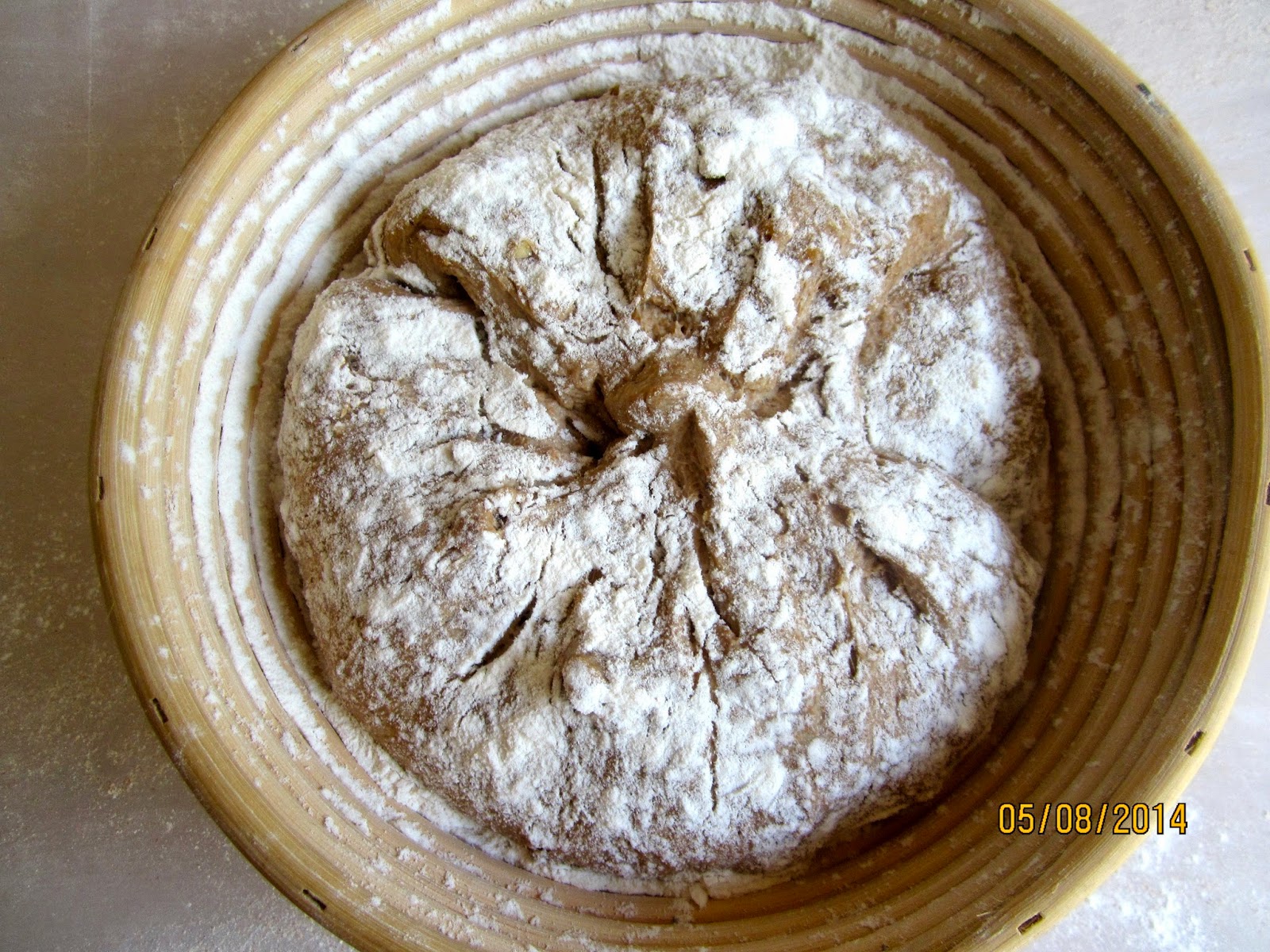
The bread has grown 1 1/2 times its original volume

Preheat oven to 425ºF/220ºC (including steam pan).

Place loaf on a parchment lined baking sheet (or bake directly on a baking stone). Score as desired.

Score before baking

Bake at 350ºF/175ºC (with steam). After 20 minutes rotate loaf 180 degrees, remove steam pan, and continue baking for another 25 minutes, until dark golden brown (internal temperature about 200ºF/93ºC).

Let cool on wire rack.

A very tasty bread!

Submitted to      Yeast Spotting
and Panissimo:  Bread & Companatico                                       
                           Sono io, Sandra


Monday, March 17, 2014

LET'S BUILD A BREAD - PAIN AU LEVAIN DE SEIGLE


Hier geht's zur deutschen Version dieses Posts


Plötzblog is one of Germany's best bread baking blogs. When Lutz Geißler (author of "Das Brotbackbuch") invited us to his blog event blog-experiment: "Wir bauen uns ein Brot" (Let's build a bread), I was intrigued.

Of course I wanted to attend the very first "Bread Olympics"


Each participant has to bake a loaf, roll or small bread with these ingredients and these amounts:
  • 450 g (90%) wheat flour Typ 550 (or bread flour)
  • 50 g (10%) whole rye flour
  • 10 g (2%) salt
  • sourdough and/or yeast
  • water
And that's it: nothing else should be added.

But there are no restrictions on how to make your bread - method, level of hydration and leaven are entirely up to you.

This challenge was hard to resist, especially since the best of all husbands was still traveling all over Vietnam, and, after sanding and re-oiling all my kitchen counter tops, I could do with some entertainment.

My husband, indulging in imperial dreams in Vietnam

I knew at once what kind of loaf I wanted to create - a French bread, made with Forkish's minimalistic method, and baked in a Dutch oven. I'm really enthusiastic about how you can bake a fabulous bread that is "pinched instead of kneaded."

So I opened my BreadStorm program, entered the ingredients, and started to play around with hydration levels and percentages of pre-fermented flour.


I also had to take into account the amounts of flour in my refreshed levain - 5 g bread flour and 2 g whole rye flour - and deduct them from the total.

BreadStorm-Users (including the free version) can download the formula here 

Whether my Pain au Levain de Seigle will win at the Plötziade, or not - it definitely was a winner for me. I enjoyed its aromatic taste, crackling crust and open crumb so much that it went straight into Karin's Bread Hall of Fame!

Still a bit warm - I couldn't wait any longer!

PAIN AU LEVAIN DE SEIGLE - MY PLÖTZIADE-BREAD

1. Step-Levain (Refreshing - you will use only part of it for step 2)
10 g mature starter (what you have at hand)
40 g water (90ºF/32ºC)
40 g bread flour
10 g whole rye flour

2. Step-Levain (after 24 hours)
12 g refreshed levain (keep remainder as mother starter in the fridge)
47 g water (90ºF/32ºC)
47 g bread flour
12 g whole rye flour

Final Dough
338 g water (90ºF/32ºC)
398 g bread flour
36 g whole rye flour
10 g sea salt
118 g levain (2. step)

DAY 1
7:00 - 9:00 a.m. Feed your mature starter (step 1) (With such a small amount the hydration level of your starter doesn't really matter.) Cover and leave for 24 hours at room temperature.

Ripe levain, showing the typical sponge structure under the surface

DAY 2
7:00 - 9:00 a.m. (24 hours after refreshing the starter)
Mix 2. step-levain, cover, and leave for 7-9 hours at room temperature.

Mixing flour and water until all flour is hydrated

2:00 - 4:00 p.m.
In large bowl, mix flours and water by hand, until all flour is hydrated. Cover, and let rest for 30 minutes.

Add salt and levain to flour mixture

First pinching the dough...

...then folding it. (The last 2 photos are from other, similar breads)

Prepare bowl with water (to make your hands wet). Sprinkle salt over flour mixture and add levain.

With (wet) hands, fold dough from sides over to the center, then, working like a pincer, pinch dough several times, alternating with folding, until dough is smooth, about 5-6 times. (DDT: 77º-78ºF/25º-26ºC.)

After folding place dough ball back into bowl

Fold dough 3 times more, twice at 20 minute intervals, the last time before going to bed. Leave, well covered, at room temperature overnight.

The dough has tripled overnight

DAY 3
After 12-15 hours the dough should have tripled. Prepare a very generously floured rising basket.

Transfer dough to a floured area on an (otherwise unfloured) work surface. With floured hands, gently fold sides towards the middle to make a round. (The flour "skin" on the underside prevents sticking.)

Folding the dough from the sides to the middle

Then flip the round gently over, seam side down, onto the unfloured area. With floured hands, pull dough ball towards you, until you have a medium-tight boule.

Place dough round, seam side down, in proofing basket, sprinkle generously with flour, cover well, and proof for about 3-4 hours.

3/4 hours before baking, place Dutch oven (with lid) on the middle rack, and preheat oven to 475ºF/245ºC.  Place a piece of parchment paper on the counter (for the bread transport).

Finger poke test: a dimple that doesn't fill up again

The dough should at least double in size, use the finger poke test to decide whether it is ready to be baked.

Finger poke test:
Gently press a dimple with your finger in the dough - it should still be a bit elastic, but not fill up again, and stay visible. 

Cutting parchment paper to make a sling for the bread

Place bread on prepared parchment paper, smacking the banneton energetically on the counter! Cut paper around the bread, leaving 2 long pieces as handles, to make a sling. (Clipping the paper prevents creases from cutting into the bread.)

i
Using a paper sling makes transferring the bread to the hot pot easy

Remove hot Dutch oven from oven, and put bread (with paper) into it. Replace the lid.

Bake for 30 minutes, then remove the lid, and bake it for 20-25 minutes more, or until bread is medium to dark brown (internal temperature 210ºF/99ºC).

Tilt Dutch oven to slide bread out (the paper might now be too brittle to serve as sling), and let the loaf cool on a wire rack. Let the bread rest for at least 20 minutes before slicing - even if you, like me, have a hard time to wait!

A very tasty bread!

Submitted to Plötzblog
and Panissimo:  Bread & Companatico                                       
                           Indovina chi viene a cena