Showing posts with label Blog Event. Show all posts

Monday, October 16, 2017

POLISH POTATO BREAD - A FAVORITE LOAF FOR WORLD BREAD DAY 2017


Hier geht's zur deutschen Version dieses Posts


Before my friend "The Rye Baker" Stanley Ginsberg went on his mission promoting European rye breads to American bakers, he had published another remarkable baking book: "Inside the Jewish Bakery - Recipes and Memories from the Golden Age of Jewish Baking".

I was among his test bakers. One of my test recipes was the Polish Potato Bread - Poylner Kartoffelbroyt - with its unusually high potato content an interesting recipe, but, as I soon realized, somewhat challenging in its preparation.
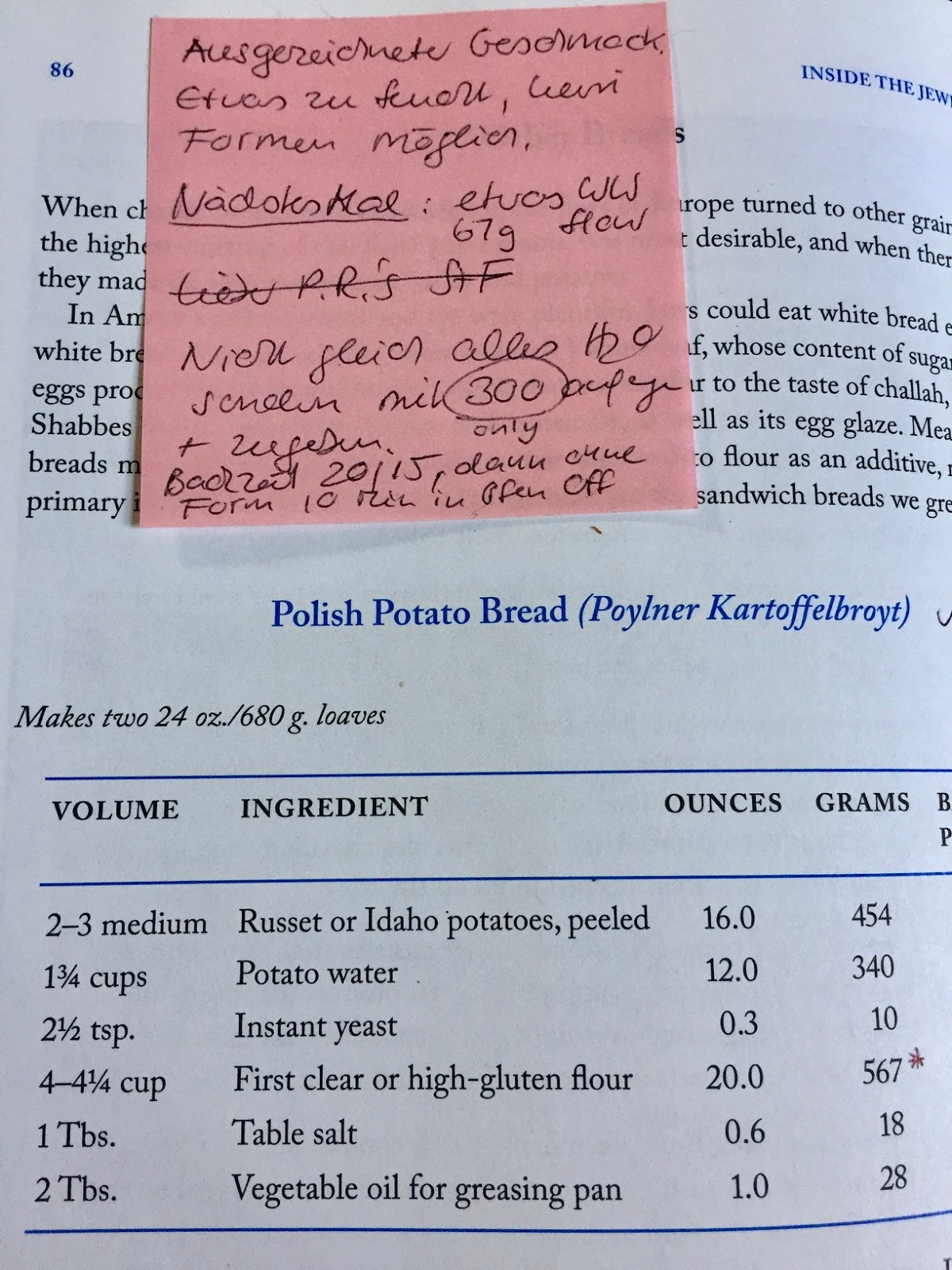
My first Post-It notes about the recipe

I had problems gauging the necessary water amount, first the dough seemed too dry, then turned sticky from the potatoes.

Not only that: Stanley had warned of dire consequences if you tried taming the gooey dough with more flour - it would turn into a brick!

Somewhat intimidated, I jotted down on my note pad: "No shaping possible".

In the end, somehow, I managed to get the sticky glob into the pan. Or I wouldn't have (later) rejoiced in its "excellent taste!"

At that time I had no whatsoever experience with stickier doughs. Meanwhile, I know better how to deal with the tricky potato bread - the extra flour needs to go on the work surface, under the dough, not into it! 

 Potato Bread tastes especially good when toasted

The excellent taste encouraged me to bake the Potato Bread again and again, while tweaking the recipe a little bit, especially withholding some of the water to (slowly) add it during the mixing later.

Allowing the dough to rest in the fridge overnight, I could reduce the amount of yeast a bit.

This favorite loaf really deserves to be presented at Zorra's World Bread Day 2017,

Golden brown and wonderfully moist

POLISH POTATO BREAD (adapted from Stanley Ginsberg's: "Inside the Jewish Bakery")

227 g/8 oz Russet or Idaho potatoes, peeled or unpeeled *), cut in chunks
170 g/12 oz potato cooking water
4 g/1 tsp instant yeast
250 g/8.8 oz first clear or high-gluten flour
34 g/1.2 oz whole wheat flour
9 g/0.3 oz salt
vegetable oil, for brushing

*) I like using local red potatoes with thin skins and don't peel those

Drain cooked potatoes and reserve 170 g of the cooking water

DAY 1
Cook potatoes in about 2 cups of unsalted water until soft, then drain, reserving 170 g/6 oz of the cooking water. Mash potatoes, and let both cool to room temperature.

Our local red potatoes don't need to be peeled

Mix mashed potatoes, flours, yeast, and 150 g/5 oz of the reserved cooking water at low speed, until all flour is hydrated, 1-2 minutes. (Dough might seem a bit dry at first, but potatoes will add more moisture).

In the beginning the dough seems relatively dry...


.... but soon becomes sticky from the potatoes

Add salt, and knead at medium-low speed for 10-12 minutes, very slowly adding remaining 20 g/2 oz water. Dough will soon become (and remain) sticky, but in the end pull back from sides of bowl. Don't add more flour, if you don't want to end up with a brick!)


Ready for its slumber in the fridge

Place dough in oiled container, cover, and place overnight in the fridge. (Using a square container helps with shaping the bread later.)

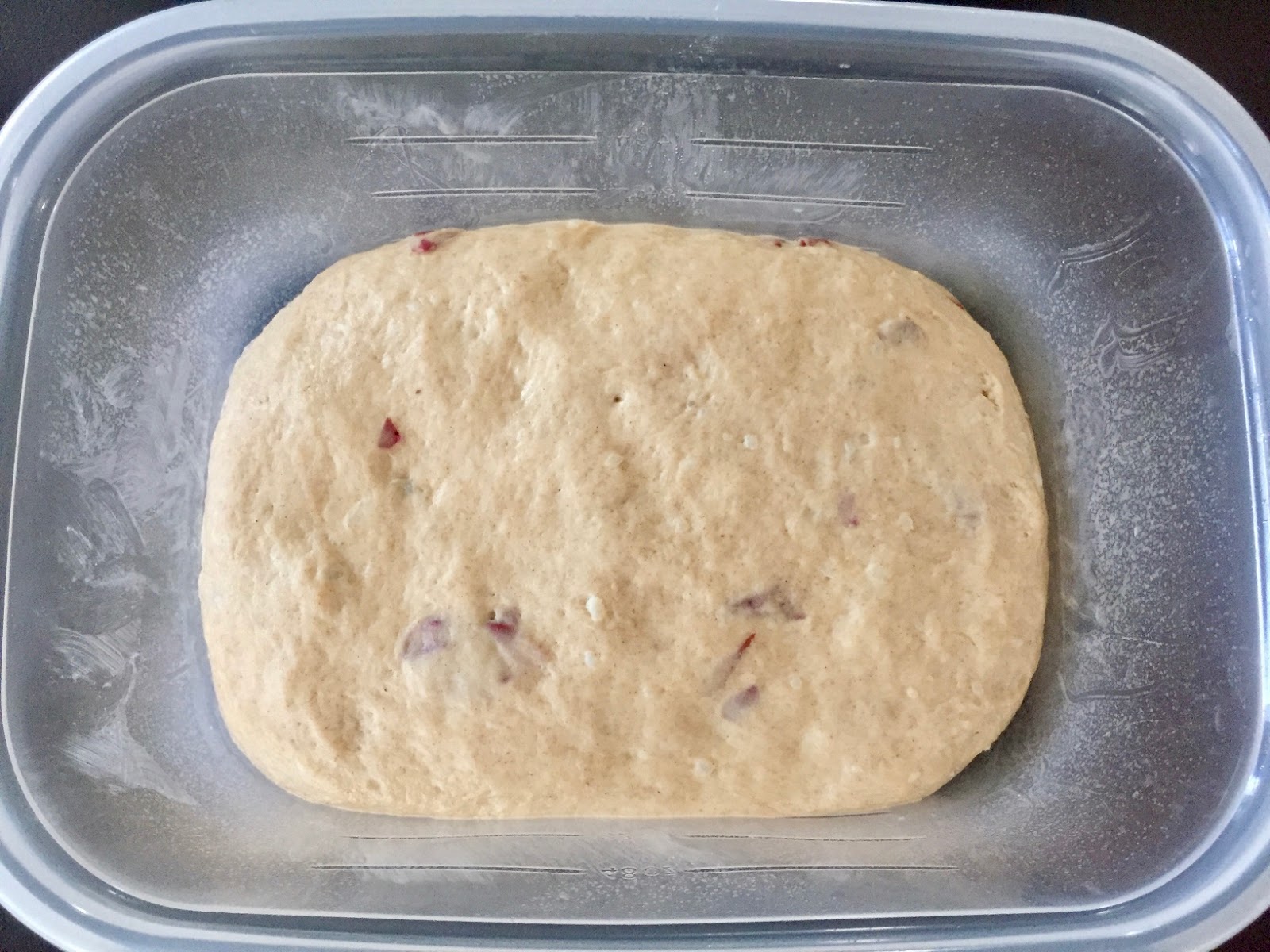
Overnight the dough has doubled in volume

DAY 2
Remove dough from refrigerator 2 hours before using. It should have doubled in volume, but will still be sticky. Grease a 9 x 5-inch/23 x 13 cm loaf pan.

The dough will still be sticky - flour your hands and bench knife!

Transfer dough to a lightly floured work surface. With floured hands (or bench knife), pat and push it into a rough rectangle. Lift one shorter end up and fold it over a little bit, pressing gently down to seal. Continue rolling up dough in the same way into a log.

Place loaf, seam-side down, in the prepared pan

Re-flour your hands, (or bench knife), and - this is the tricky part - lift the loaf cylinder up and place it, seam-side down, into prepared pan.

Brush top of loaf with oil, cover pan, and proof until top of dough has reached rim of pan, and a dimple, pressed with your finger, will not fill up at once (about 45 - 60 minutes).

Preheat oven to 375ºF/190ºC (no steam).  

Ready to be baked

Score loaf lengthwise (snipping with scissors works better for sticky a dough than a lamé.)

Bake bread for 20 minutes (no steaming), rotate pan 180 degrees for even browning, and continue to bake for about 20 minutes more, or until loaf is golden brown (internal temperature should be at least 195ºF/90ºC.)

Freshly baked Polish Potato Bread

If you like your crust to stay crispier, leave bread in switched-off oven, with door slightly ajar, for an additional 10 minutes to dry. Then turn loaf out onto rack and let it cool completely.

STORAGE: The bread keeps for at least 3 days, wrapped, at room temperature. It, also, freezes well. If you slice it before freezing it, you can take out single slices for toasting.

Baked with German flour type 1050, the crumb looks a little darker

BreadStorm users (also of the free version) can download the formula here:

Saturday, November 7, 2015

DABROWNMAN'S SWABIAN POTATO BREAD FOR GÖTZ - NEVER BAKE THE SAME LOAF TWICE!


Hier geht's zur deutschen Version dieses Posts


After a rather underwhelming bread experience in an - otherwise nice - hotel last year, I challenged my co-bloggers, facebook friends and hobby bakers from The Fresh Loaf to help fill a basket with "Bread for Götz von Berlichingen", to provide Schlosshotel Götzenburg with a better breakfast choice.

I was so happy with the interesting contributions that I promised myself to bake as many of the 30 breads as possible, and, also, to showcase some of them on my blog - like  Khalid's Götzenburg Bread from Dubai, und Britta's Double Potato Loaf for Götz from the Lower Rhine.

Just in time for Zorra's World Bread Day 2015 I was happy to present Fresh Loaf blogger Dabrownman and his Swabian Potato Bread for Götz of the Iron Fist.

Dabrownman lives and bakes in Arizona

Dabrownman - "everybody calls me Brownman" (or DBM for short) - resides with his wife, college age daughter, and dachshund Lucy in Arizona.

An architect by schooling, he designed and supervised worldwide the construction, and ran the operation of distribution centers for the food industry. "Food and Facilities is what I did the last 23 years".
Dabrownman with "Apprentice" Lucy
Meanwhile retired, he threw himself wholeheartedly into bread baking. With 429 posts since 2012, he is one of the most productive hobby bakers and bloggers that I know.

But not only his recipes with their abundance of  grains and seeds are interesting - his posts are also often very funny!

It's hard to believe, but he is proud owner of just one single baking book: Clayton's Complete Book of Breads. ("With a title like that you only need the one.")

Instead of buildings he is now designing and constructing breads, with help of his four legged "apprentice" Lucy, who obviously has a preference for hearty, crusty loaves, and loves being busy in the kitchen.

Just like her "master", Lucy can't stand the idea of baking the same old loaf twice. "It's like designing and building the same building all the time - much too boring!"

With every bread he bakes, Dabrownman feels inspired to try a new, even better loaf. He doesn't really want to waste his time "to bake over old bread. and hope to get the new bread baked!"

According to Lucy, bread baking, also, keeps the retiree too busy to hang out too often in motorcycle bars!!!

DBM's Breakfast Rolls with Snockered Fruit & Chocolate 

As you can see from the gorgeous photos on his blog (food porn alert!), the passionate baker also creates scrumptious pies and other pastries, like Whole Grain Breakfast Rolls with Snockered Fruit & Chocolate;

DBM swears by freshly milled flour: "It has a more complex flavor, a better, deeper, and more earthy taste. It also is more active in starters and levains".

Resting after a busy baking day!
For his levain he typically takes only a small amount of starter, feeding it in three steps, and then places it for 24 hours in the fridge.

He prefers yeast water over commercial yeast, and often mixes it with his starter.

DBM sifts his whole grain flour, and adds the extracted mineral-rich, coarser parts to his starter - to expedite the fermentation of the levain, and to ensure the hard bits are sufficiently soaked.

"Seems to work well - I have very active levains, and the rise and open crumb are pretty good".

Dabrownman likes Bertinet's dough processing workout, slapping the dough several times forcefully on the countertop. I prefer a gentler approach, and the - less strenous - stretch & fold à la Reinhart that I use for many of my doughs.

Though sifting and extracting the whole grain flour is a bit of an effort, the result is well worth it!

After making it twice, the crusty, hearty bread became one of my favorites (even though my crumb is darker, and not quite as open as DBM's - his extraction might be more efficient.)

An especially hearty wheat-rye bread -worthy of a knight!

DABROWNMAN'S SWABIAN POTATO BREAD FOR GÖTZ OF THE IRON FIST (adapted from DBM's blog post in The Fresh Loaf) 
Starter 
8 g mother starter (rye, wheat, spelt, 100%)
50 g old bread, crumbled (I toasted it)
20 g freshly milled, sifted whole rye flour (85% extraction) (*see preparation)
20 g freshly milled, sifted whole wheat flour (85% extraction) (*see preparation)
35 g extracted coarser rye- and wheat parts (*see preparation )
75 g bread flour
203 g potato cooking water, cooled

Final Dough
50 g freshly milled, sifted whole rye flour (85% extraction) (*see preparation)
150 g bread flour
8 g salt
2 g instant yeast
25 g potato cooking water (more as needed - I added an extra 15 g)
100 g cooked, mashed potatoes
25 g softened butter or vegetable oil (I used sunflower seed oil)

Potatoes with thin skins don't have to be peeled

PREPARATION  (85% flour extraction)
Mill about 135 g rye (not too finely - Nutrimill setting exactly between "Finer" and "Coarser"). Sift flour several times through a fine mesh strainer, to extract 15% of the coarser parts (about 18 g will be needed). Set aside both extractions separately.

Repeat this extraction procedure with the wheat. Mix the coarser, extracted wheat bits with the same amount of rye bits (a total amount of 35 g are needed for the starter.)

DAY 1
Boil unpeeled potatoes. Reserve potato cooking water, and let it cool (you will need about 250 ml/1 cup.) Potatoes with thin skins don't have to be peeled.

Mix all starter ingredients in a bowl. Cover, and leave overnight at room temperature (9 - 12 hours). It should double.

The starter should double overnight

DAY 2
Stir starter, and let double again (3 - 4 hours).

Add starter to the other dough ingredients

Mix all dough ingredients. Leave for 30 minutes, then knead at low speed for 8 minutes, adding more water as needed (dough should clear sides, but stick to bottom of bowl).

Transfer dough to a work surface lightly misted with oil or water. With oiled hands, pull and press dough into a rough square, then fold it from top and bottom like a business letter in 3 parts. Fold the same way from both sides.

Stretching and folding the dough

Gather dough package into a ball, and place, seam side down, in an oiled bowl. Cover, and let rest for 20 minutes, then repeat S & F four more times at 20 minute intervals.

Leave for about 1 hour (dough should look puffed). Generously sprinkle a rising basket with a mixture of wheat and rice flours (to prevent sticking.) For an attractive, rustic look, sprinkle the bottom of the basket with coarse ground or rolled rye or wheat.

Instead of flour, you can sprinkle the work surface with chopped rye 

Pre-shape dough into a round, then shape it into a boule. Place, seam-side up, in the prepared basket.

Dust the surface with flour, then put the basket in a large plastic bag. Refrigerate for 12 hours (overnight).

If you want to score the loaf, place it seam side up in the basket

DAY 3
Remove bread from refrigerator about 2 hours before baking, it should have almost doubled. If not, allow it to sit longer on the counter.

Overnight the bread should almost double

Preheat oven to 500ºF/260ºC, including baking stone and steaming device.

Don't be too timid when you score it!

When the bread is sufficiently proofed (finger poke test: a dimple should not fill completely up again, but remain visible), place it on a parchment lined baking sheet. Score, as desired.

Place bread in the oven, steaming with a cup of boiling water. Reduce temperature to 450ºF/ 230ºC After 15 minutes, remove steam pan, and reduce temperature to 430ºF/ 220ºC - switch to convection mode, if your oven has that feature).

Bake for another 20 - 25 minutes, until bread is nice and brown (the crust shouldn't be to light!) and it registers at least 205ºF/96ºC.

Let bread cool completely on a wire rack before slicing.

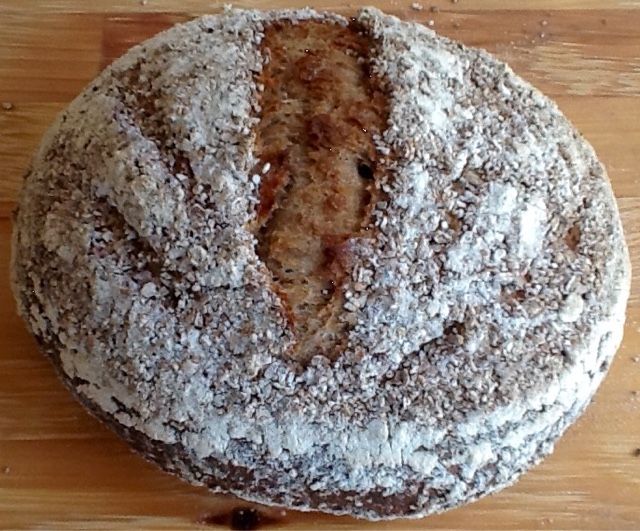
A rolled rye topping gives the bread an attractive rustic look

BreadStorm users (also the  free version) can download the formula:


Sunday, June 14, 2015

BRITTA'S DOUBLE POTATO LOAF FOR GÖTZ - BREAD FROM THE LOWER RHINE

Hier geht's zur deutschen Version dieses Posts


When I - driven from a real "Breaking Bad Bread" experience - challenged my baking buddies from The Fresh Loaf, Facebook and several congenial blogs to create a "Bread for the Knight with the Iron Hand", I promised myself to try all 30 loaves over time.

One of those congenial blogs is Britta's Brot vom Niederrhein - Bread from the Lower Rhine.

Britta, 35-year old process engineer and mother of two, named her blog after the lower Rhine region of North Rhine-Westphalia/Germany, where she lives and works.

Britta: "Others knit to relax, I bake!"

"It is pretty here, prettier than many believe. Industrial culture has its charm, the view from a heap to the blast furnaces, chimneys, and the Rhine with its many green meadows and sheep is really pretty."

Zeche-zollern-2004.jpg
The Lower Rhine with its industrial culture has its own charm - coal mine Zollern in Dortmund
Niederrhein Landschaft Natur Schafe 100330-029.jpg
Idyllic contrast to heaps and chimneys: sheep grazing on the Rhine meadows
                                                                                      
She finds baking and process engineering have a lot in common: a technical process turns the raw materials into products - only her cakes and breads rise much faster than the industrial plants she is building.

Birthday cake for little pirates!
With fond childhood memories of baking cakes with her grandmother, Britta wanted her kids to have the same experience.

Soon she progressed from simple everyday cakes to more elaborate ones, like the Pirate Ship Cake for her son's 7th birthday.

And she finally ventured into the realm of home-baked breads. But not without side effects on her married life!

"My husband got used to a fridge and kitchen counter full of (on average) seven pre-doughs on weekends".

He also has to live with the fact that she can't leave the house, because her doughs are just ready for the oven.

"Or, alternatively, listen to detailed instructions, so that HE can put the breads into the oven, at the right moment, the right temperature, with or without steam!".

The bread is made with cooked and raw potatoes
Britta started blogging to save her own recipes and show some of her breads and cakes to other enthusiasts. 

She also wants to help people with diverse food intolerances (like herself) to make delicious pastry, since that is "less easy to find in stores than bread".

Britta's Kartoffel-Weizen-Roggen-Brot intrigued me - she didn't only use cooked potatoes, but added raw potatoes, too.

It is made with two preferments:  a salted sourdough (Monheimer Salzsauer, 2% salt) and pâte fermentée, so that very little additional yeast is needed, and the aroma has time to develop overnight.

Medium wheat flour (Typ 1050), very popular in German breads, is not easily available in the US, but you can use a bread flour/whole wheat mixture instead (see my flour "translation").

German potatoes normally have thick skins, and need to be peeled. Thin skinned US potatoes can be used with their skin. Reserve the cooking water - you will need some to add to the dough later.

We liked the Double Potato Loaf a lot, it was very moist and flavorful, with a subtle hint of earthiness from the raw potatoes.

Moist and flavorful, with a hint of earthiness

BRITTA'S DOUBLE POTATO BREAD FOR GÖTZ VON BERLICHINGEN 
(adapted from Brot vom Niederrhein)


Starter (Monheimer Salzsauer)
90 g medium rye flour
90 g water
18 g rye mother starter (100%)
2 g salt

Pâte Fermentée
52 g bread flour*)
48 g whole wheat flour*)
70 g water
0.5 g instant yeast (or 1.5 g fresh yeast)

Final Dough
200 g starter (all)
170 g pâte fermentée (all)
400 g raw potatoes, grated
220 g cooked potatoes, riced or mashed (reserve cooking water!)
50 g medium rye flour
199 g bread flour*)
181 g whole wheat*)
5 g/1 tsp. molasses
13 g salt
1.5 g instant yeast (or 4.5 g fresh yeast)
more water as needed (I added 40 g potato cooking water)

*) Original recipe: medium wheat flour Typ 1050)

DAY 1
(10:00 - 12:00 am)
Mix all starter ingredients, cover, and leave for 16 - 18 hours at room temperature.

Mix ingredients for pâte fermentée at low speed for until all flour is hydrated, then knead at medium speed for about 6 minutes (DDT: 77-81ºF/25-27ºC). Cover, and leave for 1 hour at room temperature, then place in refrigerator for at least 12 hours (overnight).

You can see the little potato pieces in the dough

DAY 2
Knead all final dough ingredients for 4 minutes at low speed, then 8 minutes at medium-low speed, adding some of the potato cooking water as needed (dough should be very soft and sticky). Let it rest for 40 minutes, with one stretch & fold after 20 minutes.

Preheat oven to 482ºF/250ºC, including baking stone and steam pan.

Nicely risen dough
Shape dough into a round and place, seam side up, in a floured rising basket.

Sprinkle with flour, cover, and proof for about 45-60 minutes at room temperature, or until it has grown 1 1/2 times its original size (finger poke test: a dimple should remain visible).

Turn bread out onto a parchment lined baking sheet (or a peel to bake directly on the stone). Score.

Place bread in oven, steaming with a cup of boiling water poured in the steam pan (or whatever steaming method you prefer).

Bake for 15 minutes, remove steam pan, rotate the loaf, reduce heat to 400ºF/200ºC, and bake for another 30 - 40 minutes, until it is dark golden brown and sounds hollow when thumped on the bottom (internal temperature: 200ºF/93ºC).

BreadStorm users (also of the free version) can download the formula:


Submitted at Yeast Spotting

Tuesday, April 14, 2015

KHALID'S GÖTZENBURG-BREAD - WHOLE GRAIN BAKING IN DUBAI


Hier geht's zur deutschen Version dieses Post


When I - driven from a real "Breaking Bad Bread" experience - challenged my baking buddies from The Fresh Loaf, Facebook and several congenial blogs to create a "Bread for the Knight with the Iron Hand", I promised myself to try all 30 loaves over time.

Well, let's say, almost all of them: the original 1914 German Army Kriegsbrot I'll better keep in reserve when times get tough.

Preparing Khalid's Götzenburg-Brot, I was struck by the idea to not only present his bread on my blog, but, also, finally satisfy my curiosity, asking my Fresh Loaf friend (username: Mebake) how on earth he came to bake whole grain breads in Dubai.

Khalid bakes whole grain breads - in Dubai!

This is his answer:

It all started with an idea to make a decent whole wheat bread. I wanted to bake a healthy wholesome loaf that my wife and I would enjoy on a daily basis. In Dubai, United Arab Emirates, most bread is mass produced in commercial plants. 

I wanted something different, and so began searching online for recipes, and stumbled upon thefreshloaf.com website. Encouraged by the knowledgeable, kind, and courteous community members of the site, I learned much about bread making including pre-ferments, and the merits of slow fermentation. 

Without hesitation, I joined the community and began baking bread and sharing my results though my online blog. Prior to this point , I had never been exposed to Artisan breads of any kind.

I bought several books, read blog posts, and watched many online videos on bread making. Soon, I felt that bread making resonates well with me like no other hobby I have ever tried before. Furthermore, I was charmed by the idea of baking bread from scratch using basic ingredients. 

With no reference points, and with the help of my keen wife, I started baking feverishly. At times, she would sarcastically call the dough: the “other lady”! as I spent hours and days pouring over the bread books and trying different recipes. 

The early breads were quite sour and bitter, but as I continued to bake on a weekly basis, results where slowly improving until I finally baked a whole grain loaf I could call decent. 

After the successful bake, I began exploring rye, and soon learned to appreciate the subtle earthy-sweet flavor notes of whole grain rye breads. To improve flavor, I bought a German electric mill (Hawos –Easy) and began milling wheat and rye kernels, and using the fresh flours in my bread. The flavor was so exceptional; it was quite a revelation to me.  

Now, I have sacks of 25 kg of flour lying in my house , a  mini old fridge where freshly ground grains reside, and a recently bought 4 tray convection oven to increase my capacity. I’ve also sourced some organic Rye , and wheat flours from a German culinary wholesale distributor in Dubai. 

I have a full time desk job, but bake for a monthly local event that is held in a shopping mall in Dubai: The Arts and Crafts Market.

I hope to start an Artisan Bakery in Dubai in the not too distant future.

Khalid's breads at the Arts & Crafts Market in a Dubai shopping mall

A name (and facebook page) for his bakery exists already: The Golden Wheat Bakery!

Khalid's hearty sourdough has a slight hint of sweetness from soaked, pureed raisins. We liked it a lot, and I'll definitely bake it again.

I made two small changes to his original recipe, adding the raisin puree right away to the final dough (it appeared a bit dry), and baking the bread with steam, since I like the crust to be a bit thinner.


KHALID'S GÖTZENBURG BREAD WITH WHEAT,  RYE & SPELT

Raisin Puree
50 g/1.8 oz raisins
50 g/1.8 oz water, boiling

Levain
25 g/0.9 oz mother starter
106 g/3.7 oz water
60 g/2.1 oz bread flour
44 g/1.6 oz whole wheat flour
30 g/1.1 oz whole spelt flour
15 g/0.5 oz whole rye flour

Final Dough
100 g/3.5 oz raisin puree (all)
280 g/9.9 oz levain (all)
167 g/5.9 oz bread flour
131 g/4.6 oz whole wheat flour
87 g/3.1 oz whole spelt flour
44 g/1.6 oz whole rye flour
242 g/8.5 oz water
12 g/0.4 oz salt


DAY 1
Mix all ingredients for levain, until well combined. Cover, and leave at room temperature overnight.

In small bowl, pour boiling water over raisins. Cover, and let soak overnight.

This lively starter's origin you can find here

DAY 2
Using a blender or immersion blender, puree raisins and any remaining soaking water.

Place raisin puree, flours and water for the final dough in mixer bowl. Mix, until all flour is hydrated. Leave for 30 - 60 minutes (autolyse).

Add levain and salt, and knead at low speed for 5 minutes. Let rest for 5 minutes, then resume kneading for 2-3 minutes at medium-low speed.

Place dough in a lightly oiled bowl

Transfer dough to lightly oiled bowl, cover, and let ferment for 2 - 2 1/2 hours, with 1 x stretch & fold after 60 minutes. It should grow about 1 1/2 times its original size.

Nicely risen after 2 1/2 hours

Transfer dough to lightly floured work surface and pre-shape into a round. Cover, and let rest on the bench for 15 minutes, then shape into a boule or bâtard.

Place, seam side up, in a floured rising basket

Place, seam side up, in a well floured rising basket, sprinkle with flour, and let rise, covered, for about 2 hours, or until it has grown about 1 1/2 times its original size (a dimple, made with your finger, should come back a little, but remain visible).

The bread has grown by about 1 1/2 times its original size

Meanwhile preheat oven to 482ºF/250ºC, including baking stone and steaming device (or don't steam, if you like a rather thick crust).

Transfer bread to parchment lined baking sheet (or bake directly on baking stone). Score.

Ready for the oven

Bake for 15 minutes, with steam, then remove steam pan, rotate bread 180 degrees, and reduce temperature to 410ºF/210ºC. Bake for another 25 - 30 minutes, until crust is a dark reddish brown and the internal temperature registers at least 200ºF/93ºC.

Let bread cool completely on wire rack before slicing.

A hearty bread with a slight hint of sweetness

BreadStorm users (also of the free version) can download the formula:

Wednesday, September 10, 2014

1914 GERMAN ARMY KRIEGSBROT - RETRIEVED FROM THE TRENCHES BY DON SADOWSKY


Hier geht's zur deutschen Version dieses Posts (folgt noch)


Don Sadowsky, author of the wildly popular guest post "Really(?) Authentic Bread"
unearthed this historic WWI-recipe from the very trenches of Verdun. Even though Don's innate modesty doesn't allow him to admit it - his 1914 German Army Kriegsbrot comes pretty close to a really authentic bread!

Karin, you issued a challenge to create a bread honor of Gottfried von Berlichingen, Götz of the Iron Hand. Your friends rose to the challenge, coming up with a variety of imaginative, pretty, and well-crafted breads.

Powered by BannerFans.comNeedless to say, my bread is not any of these things.

Götz was a military man. He spent his time out in the field (when he was not being imprisoned and scratching together money to pay his own ransom).

He didn't eat light and tasty bread prepared by artisan bakers, he consumed rough and ready military bread, baked by someone who two days ago was pulling an arrow out of his leg.

Soldiers in the field needed bread that could be made quickly, could stand the rigors of the field and would last out in the open while the men were out battling.

Taste? Hah! The mercenaries ate whatever bread they could get their hands on, and you can bet that they were given bread made with the cheapest ingredients available (but don’t worry, this is not quite going to be my “authentic bread”).

What to make, then, that would satisfy such draconian requirements? Well, armies have been traveling on their stomachs for millennia, so they must have perfected the art (if art be the proper term).

German soldiers, fortified with kriegsbrot, handle the "Dicke Bertha" canon

And military history buffs can be found in every back alley of the Web, so it was easy for me to reach back just a single century and find a recipe for German Army ration bread (Kriegsbrot) from 1914 at The Trenchline (slightly adapted here - I cannot vouch for its accuracy, but we all know that everything on the Internet is true).

The bread is coarse, rises quickly, has a fair amount of rye (as a good German military bread should) a stiff dough (59% hydration), and would never win any 21st century bread competition, though some concession was made to taste (the soldiers of the Deutsches Heer must have loved their cocoa).

But it wouldn't do to simply copy an existing recipe, no matter how apt, so I made one modification to try to turn the kriegsbrot into something truly honorary of the man of the Iron Hand. Unfortunately it looks more like a tribute to Götz of the Iron Foot, no one ever accused me of being an artiste.

The bread came out about as bricky of a brick as I have ever made. It was dense enough to make a useful trenching tool or to safely intercept shrapnel if held in a fortuitous location.

Eating it made me grumpy enough to go to war (perhaps that was the intent).


In the trenches of Flanders - soldiers made good use of their kriegsbrot
  

1914 GERMAN ARMY KRIEGSBROT (KOMMISSBROT)

420 g rye flour
369 g white whole wheat flour*)
  43 g cocoa
  13 g/1.5 tbsp. active dry yeast**)
    7 g/1 tbsp. caraway seeds
  34 g/2 tsp. salt
110 g brown sugar
          vegetable oil
  28 g/2 tbsp. butter
473 g/2 cups water

*) It’s what I had, white whole wheat would have been scorned by the                                                   Kaiser's men.

**) I used instant - no slow fermentation here.

Kriegsbrot Dough

Mix flours, cocoa, caraway seed and salt in large bowl.

Mix water, brown sugar, and butter in a sauce pan and heat until dissolved. Cool slightly and add yeast. (Yes, this will rise quickly!)

Mix all of these ingredients in the large bowl and add enough vegetable oil to cover dough ball. Knead until it forms a pliable dough.

Let the dough rest in a warm place and cover it.

Grease and flour a baking sheets (bowing to convenience I used parchment paper)

When the dough has risen 2 hours, punch it down.

Roll into a ball and flatten slightly to a height of about 2 ½ inches.  (This is where I made my modification.)

Lightly brush the top with oil.

Proof for 1-2 hours.

Bake at 400 degrees for 20-25 minutes, or until it is done.

A Swiss army knife kind of a loaf