Saturday, October 19, 2013

SPELT PUMPKIN BREAD

Hier geht's zur deutschen Version dieses Posts (folgt noch)


It's October, almost November, but from the glorious sunshine and balmy temperatures you wouldn't think it is.

Only waking up when it's still dark, and having dinner in the kitchen instead of the porch are reminders of the upcoming winter.

Pumpkins are everywhere. The pumpkin dish I grew up up with, and loved, were my Pomeranian grandmother's wonderful pickled sweet and sour pumpkins.

Every year she bought one of those giant pumpkins, and, during an afternoon of hard labor, cut it down, cooked it with sugar, vinegar and spices, and filled a long line of glasses with golden pumpkin chunks embedded in aromatic syrup.

Every family member received his or her share, to be served with roasts and rice dishes.

My Omi was a great cook (with my son Per, age 3)

After "striking gold" with Dan Lepard's wonderful Pumpkin Whey Bread, I got back to one of my seasonal German breads, Kürbisbrot ("Pumpkin Bread").

It doesn't have such an interesting ingredient like whey (also hard to come by, if you are not in the yogurt making business.) But the German cousin is made with spelt, and therefore a little heartier.

The autumnal pattern is made with a large, leaf-shaped cookie cutter, pressed into the dough before it rises.

Both pumpkin breads share the same golden crumb, and nutty crunchiness from the toasted pumpkin seeds - and both taste equally good!

Golden crumb and nutty crunch makes pumpkin breads so good

 
SPELT PUMPKIN BREAD


Pumpkin puree and seeds
150 g water, lukewarm (95ºF/35ºC)
    4 g instant yeast
500 g whole spelt flour (or 1/2 spelt + 1/2  bread flour)
  11 g salt
    3 g dark brown sugar
½ tsp. cinnamon
 1 tsp. ground ginger
28 g/2 tbsp. butter, melted
212 g pumpkin puree (1/2 can)
  60 g pumpkin seeds, toasted

milk, for brushing (optional)


DAY 1
Stir yeast into the warm water, to dissolve.

Add all dough ingredients in mixing bowl. Stir together for 1 - 2 minutes at low speed (or with large wooden spoon), until all flour is hydrated. Let dough rest for 5 minutes.

Knead dough for 2 minutes at medium-low speed (or by hand), adjusting with more water as needed, (dough should be smoother but still sticky.) Continue kneading for another 4 minutes. Dough should be still slightly sticky. 

Transfer dough to lightly oiled or wet work surface. With wet or oiled hands, pat and stretch dough into a rough square. Fold it from top and bottom in thirds, like a business letter. Repeat with sides left and right.

Pick dough ball up, tucking sides under, and place it, seam side down, in a lightly oiled bowl. Cover, and let rest for 10 minutes. Repeat this stretch and fold 3 times. After the last fold, place dough in oiled container with lid, and refrigerate overnight.

The pumpkin dough has a beautiful golden color

 DAY 2
Remove dough from refrigerator 2 hours before using.

Preheat oven to 450ºF/230ºC, including a steam pan.

Shape bread into a (not too tight) ball and place it, seam side down, on a parchment lined baking sheet. Brush it with milk, and using a large leaf shaped cookie cutter, press down deeply to score. Mist loaf with spray oil and cover with plastic wrap (or clean kitchen towel).

Use a large leaf shaped cookie cutter for the scoring

Let bread ferment at room temperature for 45 - 60 minutes, until it has grown to 1 1/2 times its original size, and dough doesn't spring back when gently poked with a finger.

Place bread in oven, pour a cup of boiling water into steam pan, reduce heat to 400ºF/200ºC, and bake bread for 20 minutes. Remove steam pan, rotate loaf 180 degrees, and continue baking for another 15 - 20 minutes, until the bread is golden brown, and registers at least 195ºF/90ºC on an instant-read thermometer.

Cool bread on a wire rack.

Lighter pumpkin breads with half spelt and half bread flour.

Completely updated and re-written post (original was posted 10/2010)

Submitted to Panissimo:  Bread & Companatico                                       
                                        Indovina chi viene a cena                                             
This month's Panissimo is hosted by Menta e Rosmarino


Friday, October 4, 2013

CECILIENHOF VOLLKORNBROT - WHEN TASTE MEETS TRADITION


One of the best breads I ever made
 Hier geht's zur deutschen Version dieses Posts


During our recent trip to Germany we spent a few days in Potsdam, to visit Frederick the Great's Sanssouci. We stayed at Schlosshotel Cecilienhof, a wonderful hotel right inside another historic site, Cecilienhof Palace.

Cecilienhof Palace in Potsdam, a UNESCO world heritage site

Built 1917 by Crown Prince Wilhelm of Prussia for his wife Cecilie, Duchess of Mecklenburg, this Tudor revival style palace was also the place where these three jolly old guys met:

Churchill, Truman and Stalin at the Potsdam Conference

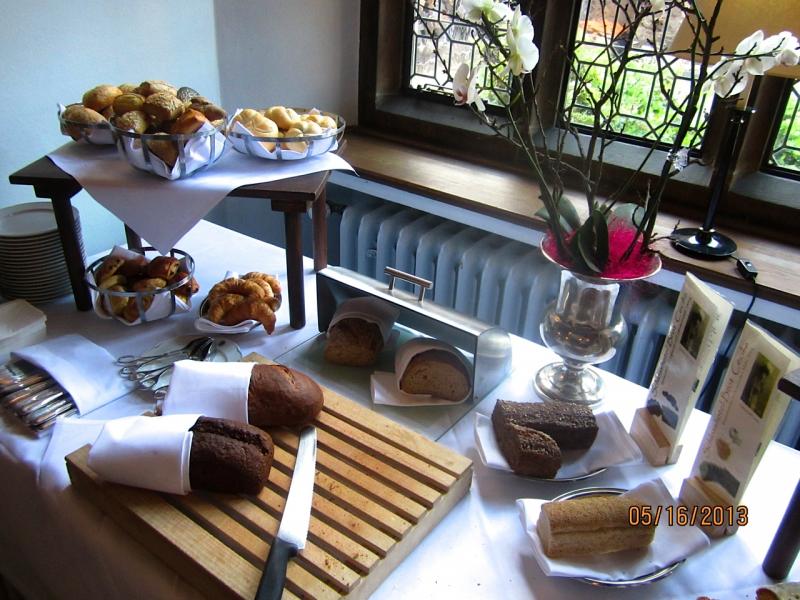
To honor the history and importance of this heritage, the hotel came up with the idea to create a special bread for the guests' breakfast buffet: an ancient grain sourdough, with a lot of different grains and seeds.

Bread buffet at Schlosshotel Cecilienhof

Multigrain bread served at Schlosshotel Cecilienhof
To educate their guests, the hotel had placed a little brochure on the table, with informations about the bread: "Taste meets Tradition", including a list of the ingredients:

List of ingredients of Cecilienhof Ancient Rye Bread
Rye meal
Water
Sunflower seeds
Ancient wheat meal: emmer and einkorn
Wheat flour (white or medium, not whole wheat)
Rolled spelt
Chestnut flour
Rolled oats
Barley meal
Barley malt extract
Vital wheat gluten
Rolled barley
Flaxseed
Steel cut oats
Spelt flour
Potato flakes
Sea salt
Vegetable fat (shortening)
Whole spelt sourdough
Table salt
Yeast

Unfortunately they didn't supply the bakers' percentage!

Though I'm not the greatest vollkornbrot fan (having been force fed as a child) I really liked the bread, and was quite intrigued by the impressive list of ingredients.

Wild Rice Sourdough - The Bread That Ended The Cold War

In my repertoire I had already one remarkable bread associated with an important historic event: Wild Rice Sourdough - The Bread That Ended The Cold War. Wouldn't it be great to add another one?

I couldn't stop thinking about it, and deemed it a challenge worthy of my talented fellow bakers at The Fresh Loaf. And they rose to the occasion!

Janet's bread


Janet Cook from Colorado bakes breads for the joy of it, though she can't eat them herself.

She modeled her Cecilienhof rye look-alike after Russian rye or Borodinsky bread (her formula and photos are in the comments.)


Dabrownman's version
Prolific multigrain/many seed baker dabrownman from Arizona likes to taunt his audience with food porn and breath taking sunrise photos.

Helped by his no-nonsense, paws-on apprentice Lucy he created this version.


Brian's loaf
Brian (Skibum) from Canada felt encouraged to go over to the "dark side" with his first ever rye vollkornbrot.

A beautiful thing to behold!


Jürgen's take on Cecilienhof bread


Jürgen Krauss (Germany/UK) baked his loaf slowly over 12 hours, like a pumpernickel.

He praised the deep flavors and great versatility of his Cecilienhof challenge bread.  


Ian's nutty bread
Ian (isand66), from New York, gave the bread his personal touch by adding poppy and sesame seeds, pecans and "a bunch of more whole grains".


Inspired by all this activity I sat down with my BreadStorm program to create my own formula. Except for the emmer, I had all the ingredients from the list in my pantry.

Two of my breads would be my base, Friesisches Schwarzbrot (Friesian Rye) and
Rheinisches Schwarzbrot (Rhineland Rye).

Friesisches Schwarzbrot

Using an intermediate dough, like the Friesian Rye (thus eliminating the need for additional yeast,) and baking my loaf like Rhineland Rye seemed a good way to do it.

Rheinisches Schwarzbrot

I also omitted the vital wheat gluten, neither wanting to make quick process with my bread, nor being so anxious that I needed a "safety net".

The bread turned out to be one of the best loaves I ever made, we absolutely LOVED it! Whether it was the complexity of the ingredients, or just an optimal process to develop and marry the different flavors I can't say.

We had it with aged provolone cheese and blackforest ham, and it also tasted wonderful with honey.

Much as I enjoyed the original in its historic ambiance - my bread can at least hold a candle to it. The best of all husbands claims its even better (what a pity you can't see my oh so modest smile!)

Here you see my baker's formula in % (BreadStorm users can download it here)


CECILIENHOF VOLLKORNBROT

Starter
26 g whole wheat mother starter
100 g rye meal
200 g water, lukewarm 

Intermediate dough
all starter
50 g rye meal (I used here a coarser grind)
13 whole wheat flour
45 g rolled spelt
30 g rolled oats
20 g barley meal
10 g spelt flour
11 g rolled barley
12 g flax seed
9 g steel-cut oats
150 g water, lukewarm

Final dough
all intermediate dough
37 g whole wheat
35 g einkorn flour
35 g farro flour
40 g chestnut flour
8 g salt
20 g barley malt syrup
120 g sunflower seeds, toasted
7 g potato flakes
7 g sunflower seed oil
50 g water

Very liquid starter

DAY 1:
Mix all ingredients for the starter, cover and leave at room temperature for 12 - 24 hours.

DAY 2:
In the morning, mix together all ingredients for intermediate dough. Cover, and leave at room temperature.

Intermediate dough

In the evening, mix together all ingredients for final dough, adjusting with more water, if necessary, to make a very sticky dough.

Fill dough into a (9-inch) sandwich loaf pan (up to 3/4), smooth top with wet hands, and sprinkle it with sunflower seeds. Mist with oil spray, cover pan with aluminum foil, and refrigerate dough overnight.

Final dough in the pan - no shaping necessary

DAY 3:
Remove bread from refrigerator 2 hours before baking, to come to room temperature.

Preheat oven to 450ºF/230ºC.

Bake bread (loosely covered with aluminum foil) at 425ºF/220ºC for 15 min. Remove foil, and bake for 40 minutes more, or until it registers at least 200ºF/93º.

Un-pan loaf onto wire rack, then mist with water, and let it cool completely before cutting.

Cecilienhof Vollkornbrot also freezes well - when it is completely cooled, wrap it in plastic and place in a ZipLock bag.

Crown Princess Cecilie, Duchess of Mecklenburg

Submitted to YeastSpotting

Submitted to Panissimo:  Bread & Companatico
                                        Indovina chi viene a cena                                             
This month's Panissimo is hosted by Simona Briciole


Tuesday, September 24, 2013

SPROUTED GRAIN BREAD

Hier geht's zur deutschen Version dieses Posts


A while ago I saw a bread recipe that intrigued me. Not only had it a lot of grains, but, also, three different kinds of sprouts: wheat, lentils and quinoa.

To make a sprouted grain bread you have to plan ahead, because it takes about 2-3 days until the first little white tips show up on the soaked grains.

Wheat, lentils and quinoa are beginning to sprout

Once sprouted, the grains are pureed into a smooth paste that, together with toasted sunflower-, pumpkin- and sesame seeds, gives this interesting bread its unique taste.

I changed the original recipe, created by "America's Test Kitchen", quite a bit. Though I don't mind a hint of sweetness, I don't like "falling into the honey jar" (as the Germans say), and 1/3 cup of honey in the dough seems a lot, even with the potentially bitter bran and fibers of the whole grains.

Pumpkin-, sunflower- and sesame seeds (I used black sesame)
Instead of long kneading I prefer stretching and folding the dough, combined with an overnight rest in the fridge.

This slow fermentation ensures good digestibility, and the aroma of the bread has more time to develop.

And, as an additional benefit, you need less yeast.

I was a bit leery whether you would taste the lentils (as I had experienced with some gluten free pastry made with bean meal.)

The bread looked so appetizing, when it came out of the oven, that we could hardly wait until it had cooled down enough to be cut.

Fortunately my fears proved to be unfounded, my sprouted grain bread was as tasty as it looked. No harsh legume aroma met our taste buds, the lentils blended harmoniously with the other ingredients.

The bread was also good for toasting, and we liked it especially with butter and honey.


SPROUTED GRAIN BREAD   (adapted from Cook's Illustrated)

Sprouted Grains
140 g/4.9 oz wheat berries     (3/4 cup)
  43 g/1.5 oz quinoa                (1/4 cup)
  41 g/1.4 oz brown lentils      (1/4 cup)
    2 cups cold water

Dough
 ½ cup warm water                 (110ºF/43ºC)
 42 g/1.5 oz honey                  (2 tbsp)
 36 g/1.3 oz sunflower seeds  (1/4 cup)
 20 g/0.7 oz pumpkin seeds    (2 tbsp)
 17 g/0.6 oz sesame seeds       (2 tbsp)
274 g/9.7 oz bread flour
    4 g/0.14 oz instant yeast
    7 g/0.25 oz salt                    (1 1/2 tsp)
1 egg white, mixed with 1 tsp. water, for brushing


DAY 1:
For the sprouted grains, combine wheat berries, quinoa, lentils and water in large bowl, cover, and let soak at room temperature for at least 12 hours (and up to 24 hours.)

DAY 2-3:
Drain grains through fine-mesh strainer (caution: if the mesh is not fine enough the quinoa seeds will fall through), then return them to the bowl.

Cover, and leave at room temperature, rinsing and draining grains daily, until small sprouts appear on each type of grain. (At this point, they can be patted dry and refrigerated for up to 1 week.)

  Puree sprouted grains in food processor to a sticky paste

DAY 3-4:
Process sprouted grains in food processor to a smooth, sticky paste, 2-3 minutes.

Combine seeds in small bowl. Toast 45 g/6 tbsp. of the seeds (reserve remaining seeds for topping.) Whisk water and honey together in measuring cup. 

Combine sprouted grains, bread flour, yeast, and salt in bowl of stand mixer with dough hook. Add water/honey mixture, while mixing on low speed for 1-2 minutes, until dough comes together and all flour is hydrated. Let it rest for 5 minutes.

Knead dough on medium-low speed for 6 minutes, slowly adding toasted seeds until dough is smooth, elastic, but still a bit sticky (dough should clear sides of bowl, but stick a bit to bottom.)

Transfer dough to lightly oiled or wet counter. With oiled or wet hands, stretch into a rough square, and fold from top and bottom in thirds, like business letter. Then fold from both sides. Gather dough into a ball, and place, seam side down, into lightly oiled bowl. Cover, and let it rest for 10 minutes.

After the last fold refrigerate the dough overnight

Repeat this stretching and folding 3 times in 10 minute intervals. After the last fold, place dough in refrigerator for a slow overnight rise.


DAY 4-5:
Remove dough from refrigerator, and let sit at room temperature for 2 hours, or until almost doubled in size.

Over night the dough has almost doubled

Preheat oven to 425ºF/220ºC. Line baking sheet with parchment paper.

Shape dough into a round, and place it, seam side down on prepared baking sheet. Brush bread with egg wash and sprinkle with reserved seeds. (No slashing needed.)

Sprinkled with seeds the bread looks pretty good already

Cover, and let bread rise for about 45 - 60 minutes, until nearly grown to double its original size (finger probe: a dimple made with a finger should not close again).

Bake bread at 350ºF/175ºC for 20 minutes, rotate 180 degrees, and continue baking for another 20-30 minutes, until it is golden brown, sounds hollow when thumped on the bottom, and registers 210ºF/99ºC on an instant read thermometer.

Let bread cool on wire rack.

Tastes good as BLT-sandwich, too!


Submitted to YeastSpotting
Submitted to Panissimo:  Bread & Companatico
                                        Indovina chi viene a cena                                            


Monday, September 9, 2013

DOUBLE CHOCOLATE ZUCCHINI MUFFINS

Hier geht's zur deutschen Version dieses Posts (folgt noch)


As a psychiatrist I'm used to prescribe antidepressants. Dark chocolate is my recommended mood enhancer number one.

It also provides protection from the dangers of starvation, a fact my mother recognized early (Dark Chocolate with Orange Bits), and then shared with me (Dark Chocolate with Hazelnuts).

And every physician and every mother knows: veggies are good for you! Therefore, Hanaâ's
ABC pick of the month, Double Chocolate Zucchini Bread, had to be healthy and wholesome. DOUBLE chocolate!!! Vitamin C and fibers!

Shredded zucchini - the secret to very moist muffins

Instead of baking one large coffee cake, I prefer, like several other Avid Bakers, smaller, individual portions, and, since we are only two, halved the recipe to make six square muffins.

Though I usually reduce the amount of sweetener, I'm cautious when a recipe contains cocoa, and only rounded honey and sugar a bit down. Following some reviewers' advice, I cut down on the salt.

The (optional) espresso powder is, in my opinion, a must, since coffee deepens chocolate flavor (and vice versa!) And I substituted a quarter of the white flour with whole wheat pastry flour.

While watching the baking muffins, I was a bit anxious about all that juice bubbling out on top. The recipe didn't mention draining the shredded zucchini, or patting it dry, and I wasn't quite sure whether enough liquid would evaporate.

But after 30 minutes baking time, the needle drew only a smear of molten chocolate from the tested muffin, and the top was nice and springy when gently pressed.

The muffins taste best when still a bit warm, and the chocolate melted

The muffins were very moist, thanks to their veggie add-in, and had a deep, rich chocolate flavor. They could still have been a little less sweet in my opinion, but Richard, the best of all husbands, proclaimed them to be "just right".


DOUBLE CHOCOLATE ZUCCHINI MUFFINS  (adapted from King Arthur Flour)
(12 muffins)

    2 large eggs
100 g/3.5 oz honey  
  99 g/3.5 oz vegetable oil  (1/2 cup)
  90 g/3.18 oz brown sugar
    1 tsp vanilla extract
1/2 tsp salt 
1/2 tsp baking soda
1/2 tsp baking powder
1/2 tsp espresso powder 
  28 g/1 oz Dutch-process cocoa
150 g/5.3 oz all-purpose flour
  52 g/1.83 oz whole wheat pastry flour
340 g/12 oz shredded, unpeeled zucchini (about 2 medium-small zucchini)
170 g/6 oz semi-sweet chocolate chips (1 cup)

Mixing dry into wet ingredients

Preheat oven to 350°F. Grease cups of muffin pan with baking spray.

In large bowl, beat eggs, honey, oil, sugar, and vanilla until smooth.

In second bowl, whisk together salt, baking soda, baking powder, espresso, cocoa, and flours, until well combined. Add dry to wet ingredients and mix, until just combined. 

Folding zucchini and chocolate chips into the batter

Fold in zucchini and chocolate chips.

Pour batter into prepared cups of muffin pan (up to 3/4).

Filling the muffin cups

Bake muffins for 20-30 minutes, until toothpick comes out clean (save for smear of melted chocolate chips).

Let muffins cool for 10 to 15 minutes in the pan, before turning them out onto wire rack.

Fresh out of the oven

The muffins taste best when still a bit warm, and the chocolate melted. Pairing them with vanilla ice cream definitely enhances their antidepressant properties (psychiatrist recommended!)

Keep them at room temperature. If you can't eat the muffins within 2 days, freeze them.


If you would like to join us ABC bakers, check out Hanaâ's Avid Baker's Challenge. We bake one sweet or savory bread or pastry every month (this year from King Arthur Flour website.)

Sunday, September 8, 2013

PECAN OR HAZELNUT ROLLS

Hier geht's zur deutschen Version dieses Posts (folgt noch)


Nuts are my favorite snack, when I'm starting to get hungry, and try to stay away from our little hoard of German chocolate bars (no, not that kind, I mean the real thing: Ritter Sport!)

I remember my mother coming home from her gynecologist's office, always grabbing some chocolate, before she started cooking our dinner. I must have inherited that from her, same as her gene for high dessert priority.

Both combined are a sure recipe for waistline disaster, but I have my first aid in the kitchen drawer, almonds or walnuts: good fat plus high fiber.

Being an optimist, I even planted hazelnuts in our garden, hoping for a harvest some year soon.

My precious little hazelnut

I'm very fond of baking with nuts, too, whether in cakes (Hazelnut Chocolate Cake) or breads. But when I started baking breads for sale, I was confronted me with a dilemma.

In Europe, hazelnuts are abundant, they grow wild, are easy to cultivate, and very tasty. And cheap! But here in the US, they cost a fortune and are often hard to find. So I had to use a different kind of nut for my breads in order to keep them affordable for my customers.

For this recipe, adapted from "Brot aus Südtirol", pecans are a great alternative. The rolls taste a little different, but equally good. (Much as I like walnuts, here there are not a good choice).

Pecan Rolls

Meanwhile, thanks to Trader Joe's, I can get hazelnuts for a reasonable price and good quality. With Aldi, the popular German chain for cheap skates, as parent company, they offer a lot of European goods.

Whenever we are in Portland, Maine, we stock up on Irish butter, German beer, Italian truffle cheese, and, of course, HAZELNUTS!

Toasted hazelnuts or pecans - you cant go wrong with either
PECAN OR HAZELNUT ROLLS
(12 rolls)

340 g/12 oz water (at 95ºF/35ºC)
    5 g/0.18 oz instant yeast
150 g/5.3 oz hazelnuts or pecans, toasted
350 g/12.4 oz Italian 00 flour*)
100 g/3.5 oz rye flour
  50 g/1.8 oz spelt flour
  10 g/0.35 oz salt
    5 g/0.18 oz light brown sugar
1 egg, mixed with 2 tsp. water, for egg wash
hazelnuts or pecans, whole or chopped, for decoration

*) can be substituted with pastry flour, but NOT with all-purpose flour!

DAY 1
Stir yeast in warm water to dissolve.

Place toasted nuts in food processor, and  ground to a coarse meal with some larger pieces remaining. (If you prefer a finer meal, add some of the flour to the nuts to prevent them from turning into nut butter!).

Add all dough ingredients to mixing bowl. Mix at low speed (or with a large wooden spoon) for 1 - 2 minutes, until all flour is hydrated. Let dough rest for 5 minutes.

Resume kneading at medium-low speed (or by hand), adjusting with a little more water if needed (dough should be a bit sticky). Knead for 6 more minutes (dough should still be more sticky than tacky)

Transfer dough to an oiled (or lightly wet) work surface, and, with wet or oiled hands, pat and stretch it into a rough rectangle. Then fold it from top and bottom in thirds like a business letter and repeat this folding from both sides. Gather dough into a ball, and place, seamside down, in a lightly oiled bowl.

Cover, and let dough rest for 10 minutes. Repeat the stretching and folding process 3 times, at 10 minute intervals. After the last fold, place dough in oiled container and refrigerate overnight.

DAY 2
Shape cold dough first into 12 rolls, then roll them with your hands into strands. Place rolls on perforated or parchment lined baking sheet. Using a metal spatula (or back of a knife), press a deep crease lengthwise in each roll (don't cut through bottom!). Brush rolls with egg wash, and decorate with nuts.

Mist rolls with spray oil, cover, and let rise for 45 - 60 minutes at room temperature, or until they have grown 1 1/2 times their original size, and stay dimpled when poked. In the meantime, preheat oven to 410ºF/210ºC.

Re-press the crease, if necessary. Bake rolls for 12 minutes, rotate baking sheet 180 degrees, and continue baking for another 12 minutes, or until they are rich golden brown.

Let rolls cool on wire rack.

(Based on Richard Ploner's Haselnussbrot from "Brot aus Südtirol") 

Hazelnut Rolls, lighter in color than Pecan Rolls

Completely updated and re-written post (from June 2011)

Submitted to YeastSpotting

Submitted to Panissimo:  Bread & Companatico
                                        Indovina chi viene a cena