Showing posts with label Potatoes. Show all posts

Monday, October 16, 2017

POLISH POTATO BREAD - A FAVORITE LOAF FOR WORLD BREAD DAY 2017


Hier geht's zur deutschen Version dieses Posts


Before my friend "The Rye Baker" Stanley Ginsberg went on his mission promoting European rye breads to American bakers, he had published another remarkable baking book: "Inside the Jewish Bakery - Recipes and Memories from the Golden Age of Jewish Baking".

I was among his test bakers. One of my test recipes was the Polish Potato Bread - Poylner Kartoffelbroyt - with its unusually high potato content an interesting recipe, but, as I soon realized, somewhat challenging in its preparation.
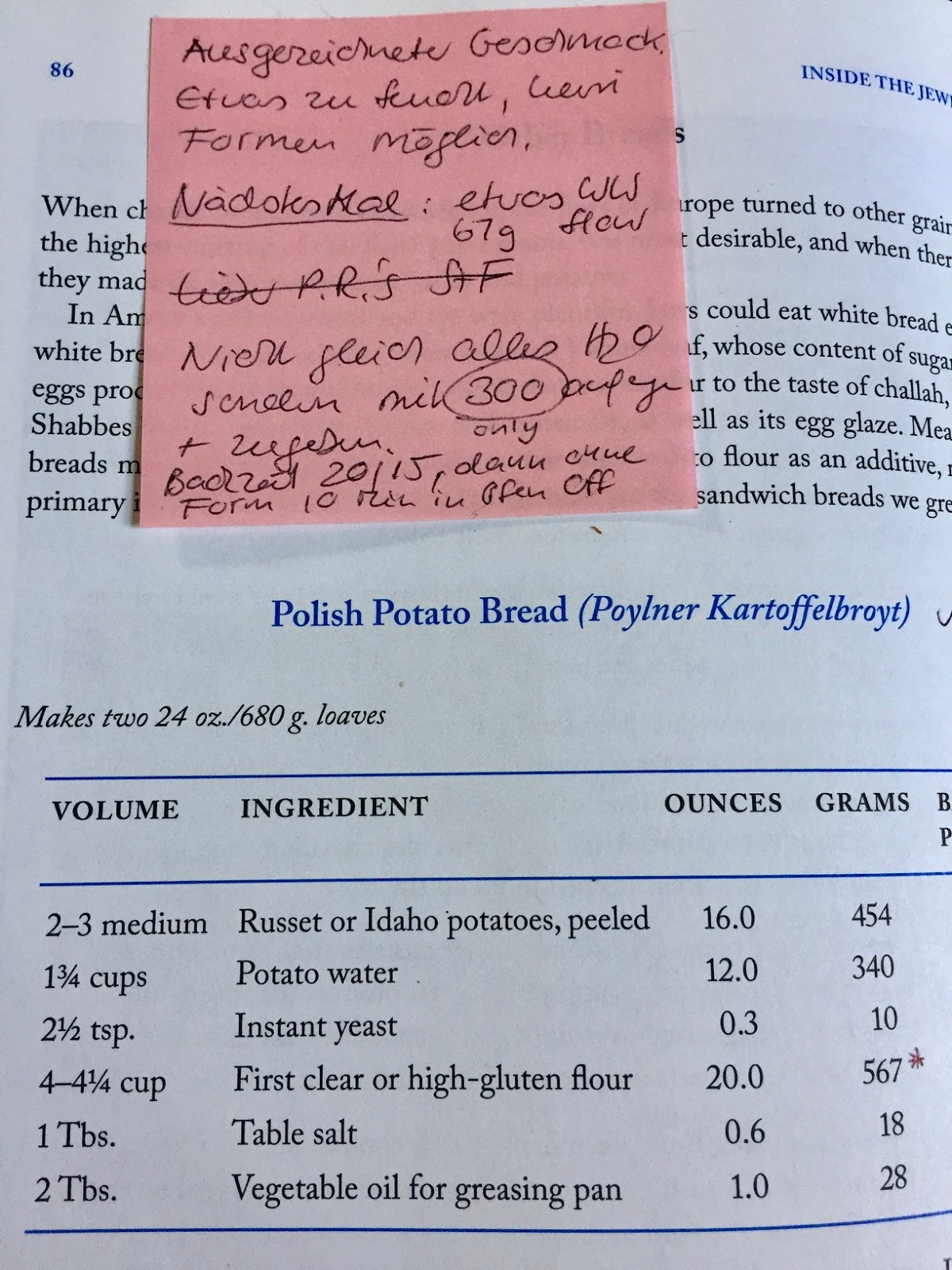
My first Post-It notes about the recipe

I had problems gauging the necessary water amount, first the dough seemed too dry, then turned sticky from the potatoes.

Not only that: Stanley had warned of dire consequences if you tried taming the gooey dough with more flour - it would turn into a brick!

Somewhat intimidated, I jotted down on my note pad: "No shaping possible".

In the end, somehow, I managed to get the sticky glob into the pan. Or I wouldn't have (later) rejoiced in its "excellent taste!"

At that time I had no whatsoever experience with stickier doughs. Meanwhile, I know better how to deal with the tricky potato bread - the extra flour needs to go on the work surface, under the dough, not into it! 

 Potato Bread tastes especially good when toasted

The excellent taste encouraged me to bake the Potato Bread again and again, while tweaking the recipe a little bit, especially withholding some of the water to (slowly) add it during the mixing later.

Allowing the dough to rest in the fridge overnight, I could reduce the amount of yeast a bit.

This favorite loaf really deserves to be presented at Zorra's World Bread Day 2017,

Golden brown and wonderfully moist

POLISH POTATO BREAD (adapted from Stanley Ginsberg's: "Inside the Jewish Bakery")

227 g/8 oz Russet or Idaho potatoes, peeled or unpeeled *), cut in chunks
170 g/12 oz potato cooking water
4 g/1 tsp instant yeast
250 g/8.8 oz first clear or high-gluten flour
34 g/1.2 oz whole wheat flour
9 g/0.3 oz salt
vegetable oil, for brushing

*) I like using local red potatoes with thin skins and don't peel those

Drain cooked potatoes and reserve 170 g of the cooking water

DAY 1
Cook potatoes in about 2 cups of unsalted water until soft, then drain, reserving 170 g/6 oz of the cooking water. Mash potatoes, and let both cool to room temperature.

Our local red potatoes don't need to be peeled

Mix mashed potatoes, flours, yeast, and 150 g/5 oz of the reserved cooking water at low speed, until all flour is hydrated, 1-2 minutes. (Dough might seem a bit dry at first, but potatoes will add more moisture).

In the beginning the dough seems relatively dry...


.... but soon becomes sticky from the potatoes

Add salt, and knead at medium-low speed for 10-12 minutes, very slowly adding remaining 20 g/2 oz water. Dough will soon become (and remain) sticky, but in the end pull back from sides of bowl. Don't add more flour, if you don't want to end up with a brick!)


Ready for its slumber in the fridge

Place dough in oiled container, cover, and place overnight in the fridge. (Using a square container helps with shaping the bread later.)

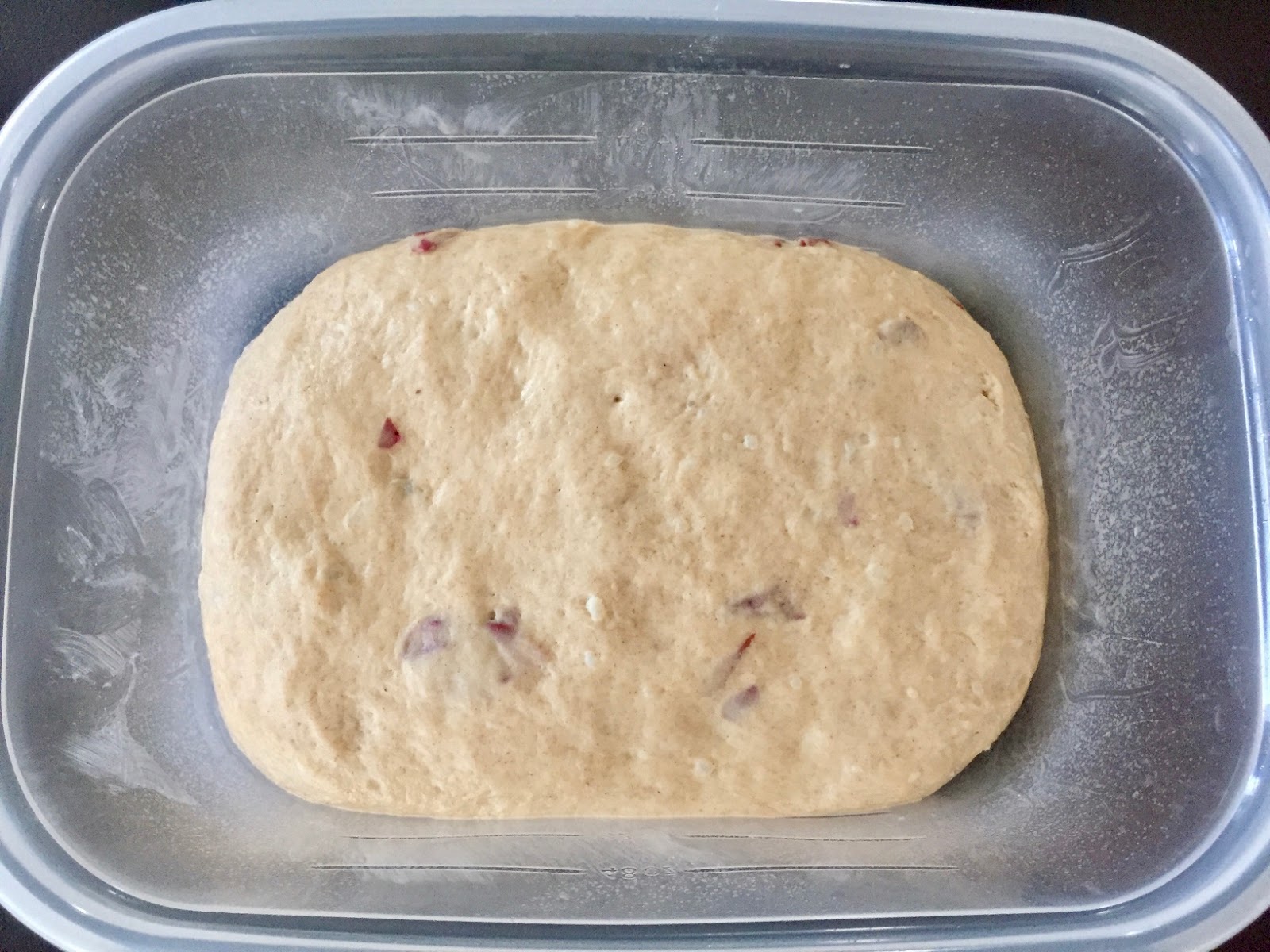
Overnight the dough has doubled in volume

DAY 2
Remove dough from refrigerator 2 hours before using. It should have doubled in volume, but will still be sticky. Grease a 9 x 5-inch/23 x 13 cm loaf pan.

The dough will still be sticky - flour your hands and bench knife!

Transfer dough to a lightly floured work surface. With floured hands (or bench knife), pat and push it into a rough rectangle. Lift one shorter end up and fold it over a little bit, pressing gently down to seal. Continue rolling up dough in the same way into a log.

Place loaf, seam-side down, in the prepared pan

Re-flour your hands, (or bench knife), and - this is the tricky part - lift the loaf cylinder up and place it, seam-side down, into prepared pan.

Brush top of loaf with oil, cover pan, and proof until top of dough has reached rim of pan, and a dimple, pressed with your finger, will not fill up at once (about 45 - 60 minutes).

Preheat oven to 375ºF/190ºC (no steam).  

Ready to be baked

Score loaf lengthwise (snipping with scissors works better for sticky a dough than a lamé.)

Bake bread for 20 minutes (no steaming), rotate pan 180 degrees for even browning, and continue to bake for about 20 minutes more, or until loaf is golden brown (internal temperature should be at least 195ºF/90ºC.)

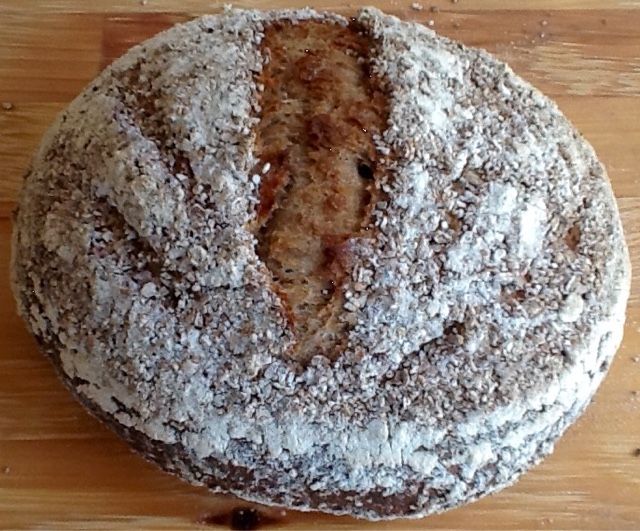
Freshly baked Polish Potato Bread

If you like your crust to stay crispier, leave bread in switched-off oven, with door slightly ajar, for an additional 10 minutes to dry. Then turn loaf out onto rack and let it cool completely.

STORAGE: The bread keeps for at least 3 days, wrapped, at room temperature. It, also, freezes well. If you slice it before freezing it, you can take out single slices for toasting.

Baked with German flour type 1050, the crumb looks a little darker

BreadStorm users (also of the free version) can download the formula here:

Saturday, November 7, 2015

DABROWNMAN'S SWABIAN POTATO BREAD FOR GÖTZ - NEVER BAKE THE SAME LOAF TWICE!


Hier geht's zur deutschen Version dieses Posts


After a rather underwhelming bread experience in an - otherwise nice - hotel last year, I challenged my co-bloggers, facebook friends and hobby bakers from The Fresh Loaf to help fill a basket with "Bread for Götz von Berlichingen", to provide Schlosshotel Götzenburg with a better breakfast choice.

I was so happy with the interesting contributions that I promised myself to bake as many of the 30 breads as possible, and, also, to showcase some of them on my blog - like  Khalid's Götzenburg Bread from Dubai, und Britta's Double Potato Loaf for Götz from the Lower Rhine.

Just in time for Zorra's World Bread Day 2015 I was happy to present Fresh Loaf blogger Dabrownman and his Swabian Potato Bread for Götz of the Iron Fist.

Dabrownman lives and bakes in Arizona

Dabrownman - "everybody calls me Brownman" (or DBM for short) - resides with his wife, college age daughter, and dachshund Lucy in Arizona.

An architect by schooling, he designed and supervised worldwide the construction, and ran the operation of distribution centers for the food industry. "Food and Facilities is what I did the last 23 years".
Dabrownman with "Apprentice" Lucy
Meanwhile retired, he threw himself wholeheartedly into bread baking. With 429 posts since 2012, he is one of the most productive hobby bakers and bloggers that I know.

But not only his recipes with their abundance of  grains and seeds are interesting - his posts are also often very funny!

It's hard to believe, but he is proud owner of just one single baking book: Clayton's Complete Book of Breads. ("With a title like that you only need the one.")

Instead of buildings he is now designing and constructing breads, with help of his four legged "apprentice" Lucy, who obviously has a preference for hearty, crusty loaves, and loves being busy in the kitchen.

Just like her "master", Lucy can't stand the idea of baking the same old loaf twice. "It's like designing and building the same building all the time - much too boring!"

With every bread he bakes, Dabrownman feels inspired to try a new, even better loaf. He doesn't really want to waste his time "to bake over old bread. and hope to get the new bread baked!"

According to Lucy, bread baking, also, keeps the retiree too busy to hang out too often in motorcycle bars!!!

DBM's Breakfast Rolls with Snockered Fruit & Chocolate 

As you can see from the gorgeous photos on his blog (food porn alert!), the passionate baker also creates scrumptious pies and other pastries, like Whole Grain Breakfast Rolls with Snockered Fruit & Chocolate;

DBM swears by freshly milled flour: "It has a more complex flavor, a better, deeper, and more earthy taste. It also is more active in starters and levains".

Resting after a busy baking day!
For his levain he typically takes only a small amount of starter, feeding it in three steps, and then places it for 24 hours in the fridge.

He prefers yeast water over commercial yeast, and often mixes it with his starter.

DBM sifts his whole grain flour, and adds the extracted mineral-rich, coarser parts to his starter - to expedite the fermentation of the levain, and to ensure the hard bits are sufficiently soaked.

"Seems to work well - I have very active levains, and the rise and open crumb are pretty good".

Dabrownman likes Bertinet's dough processing workout, slapping the dough several times forcefully on the countertop. I prefer a gentler approach, and the - less strenous - stretch & fold à la Reinhart that I use for many of my doughs.

Though sifting and extracting the whole grain flour is a bit of an effort, the result is well worth it!

After making it twice, the crusty, hearty bread became one of my favorites (even though my crumb is darker, and not quite as open as DBM's - his extraction might be more efficient.)

An especially hearty wheat-rye bread -worthy of a knight!

DABROWNMAN'S SWABIAN POTATO BREAD FOR GÖTZ OF THE IRON FIST (adapted from DBM's blog post in The Fresh Loaf) 
Starter 
8 g mother starter (rye, wheat, spelt, 100%)
50 g old bread, crumbled (I toasted it)
20 g freshly milled, sifted whole rye flour (85% extraction) (*see preparation)
20 g freshly milled, sifted whole wheat flour (85% extraction) (*see preparation)
35 g extracted coarser rye- and wheat parts (*see preparation )
75 g bread flour
203 g potato cooking water, cooled

Final Dough
50 g freshly milled, sifted whole rye flour (85% extraction) (*see preparation)
150 g bread flour
8 g salt
2 g instant yeast
25 g potato cooking water (more as needed - I added an extra 15 g)
100 g cooked, mashed potatoes
25 g softened butter or vegetable oil (I used sunflower seed oil)

Potatoes with thin skins don't have to be peeled

PREPARATION  (85% flour extraction)
Mill about 135 g rye (not too finely - Nutrimill setting exactly between "Finer" and "Coarser"). Sift flour several times through a fine mesh strainer, to extract 15% of the coarser parts (about 18 g will be needed). Set aside both extractions separately.

Repeat this extraction procedure with the wheat. Mix the coarser, extracted wheat bits with the same amount of rye bits (a total amount of 35 g are needed for the starter.)

DAY 1
Boil unpeeled potatoes. Reserve potato cooking water, and let it cool (you will need about 250 ml/1 cup.) Potatoes with thin skins don't have to be peeled.

Mix all starter ingredients in a bowl. Cover, and leave overnight at room temperature (9 - 12 hours). It should double.

The starter should double overnight

DAY 2
Stir starter, and let double again (3 - 4 hours).

Add starter to the other dough ingredients

Mix all dough ingredients. Leave for 30 minutes, then knead at low speed for 8 minutes, adding more water as needed (dough should clear sides, but stick to bottom of bowl).

Transfer dough to a work surface lightly misted with oil or water. With oiled hands, pull and press dough into a rough square, then fold it from top and bottom like a business letter in 3 parts. Fold the same way from both sides.

Stretching and folding the dough

Gather dough package into a ball, and place, seam side down, in an oiled bowl. Cover, and let rest for 20 minutes, then repeat S & F four more times at 20 minute intervals.

Leave for about 1 hour (dough should look puffed). Generously sprinkle a rising basket with a mixture of wheat and rice flours (to prevent sticking.) For an attractive, rustic look, sprinkle the bottom of the basket with coarse ground or rolled rye or wheat.

Instead of flour, you can sprinkle the work surface with chopped rye 

Pre-shape dough into a round, then shape it into a boule. Place, seam-side up, in the prepared basket.

Dust the surface with flour, then put the basket in a large plastic bag. Refrigerate for 12 hours (overnight).

If you want to score the loaf, place it seam side up in the basket

DAY 3
Remove bread from refrigerator about 2 hours before baking, it should have almost doubled. If not, allow it to sit longer on the counter.

Overnight the bread should almost double

Preheat oven to 500ºF/260ºC, including baking stone and steaming device.

Don't be too timid when you score it!

When the bread is sufficiently proofed (finger poke test: a dimple should not fill completely up again, but remain visible), place it on a parchment lined baking sheet. Score, as desired.

Place bread in the oven, steaming with a cup of boiling water. Reduce temperature to 450ºF/ 230ºC After 15 minutes, remove steam pan, and reduce temperature to 430ºF/ 220ºC - switch to convection mode, if your oven has that feature).

Bake for another 20 - 25 minutes, until bread is nice and brown (the crust shouldn't be to light!) and it registers at least 205ºF/96ºC.

Let bread cool completely on a wire rack before slicing.

A rolled rye topping gives the bread an attractive rustic look

BreadStorm users (also the  free version) can download the formula:


Friday, September 25, 2015

POTATO ALE BREAD - MADE WITH A BOOZY MASH-FED STARTER

Hier geht's zur deutschen Version dieses Posts (folgt noch)


In 2007, after baking my way through all my old German bread baking books and Peter Reinhart's "The Bread Baker's Apprentice", I checked for more bread formulas in the internet.

In German food magazine Essen & Trinken, one recipe, featuring beer - always a plus! - caught my eye and piqued my interest. The beer was not only used to hydrate and flavor the dough, but, also, cooked into a mash, to feed the starter!

At that time I had the opportunity to chat with Peter Reinhart in an online bread baking Q & A, hosted by "Fine Cooking", and asked him about the boozy, mash-fed starter. He had never heard of such a thing, either.

Not only that - there was another oddity: the recipe described stretching and folding the dough into a neat package, at one hour intervals. What an entirely weird concept! I was puzzled and very intrigued. (Later I found out that S & F as a technique was first mentioned in The Fresh Loaf in 2006. Reinhart's "Artisan Bread Every Day", introducing a larger audience to S & F, was published in 2009).

Stretching and folding a dough - to me (in 2007) a totally alien concept!

A bit skeptical how this could work, I went ahead with the Englisches Kartoffelbrot mit Ale (English Potato Bread with Ale), stretching and folding the dough as per instruction, and was a bit surprised when I saw how the dough became smoother, more elastic, and really showed little gas bubbles, when I cut it to check the development.

My first trial resulted in a very nice tasting bread. But I wasn't quite satisfied with the rather thick and chewy crust. My scoring could have been better, and I didn't think making two long bâtards was the best way to shape it, either.

My first trial - great taste but thick, chewy crust

Over the years, I now and then went back to the curious Potato Ale Bread, adding a soaker to soften the whole wheat, raising the oven temperature in the beginning, and using steam to achieve a thin, crisp crust.

We really like this bread, it is one of the standards I make for myself. My thanks to Flor, the user who posted the original formula, for introducing me to S&F (Stretch & Fold), and a starter that likes ale - same as the baker!


POTATO ALE BREAD (adapted from Flor's Englisches Kartoffelbrot mit Ale)

Potato
150 g potato, unpeeled (if the skin isn't too thick)
water for cooking (reserve 225 g for dough)

Soaker
250 g whole wheat flour
50 g bread flour
4 g salt
225 g potato cooking water, at room temperature (70ºF/21ºC)

Ale Mash
125 g ale
25 g whole wheat flour

Starter
all ale mash (lukewarm)
50 g whole wheat mother starter (or what kind of starter you have at hand)

Final Dough
all starter
all soaker
150 g cooked potato
200 g bread flour
9 g salt

Mash cooked potato or cut it in small cubes

DAY 1
Cook potato in water until soft. Measure 225 g of the potato water, and set aside to cool to room temperature. Mash, or cut potato in small pieces, place in small bowl, cover, and refrigerate until using.

For the soaker, mix all ingredients in small bowl, cover, and leave at room temperature overnight.

Cook ale/wheat mixture until it thickens to a cream

For the mash, stir together ale and flour in medium sauce pan until well combined. Heat mixture to 167ºF/75ºC, stirring constantly, until it thickens to a cream. Transfer mash to a medium bowl, cover, and let cool until only lukewarm.

Stir mother starter into cooled ale mash until well combined. Cover, and ferment at room temperature overnight.

Mix mother starter with lukewarm ale mash

DAY 2
Mix final dough ingredients at low speed until all flour is hydrated, 1-2 minutes. Let rest for 10 minutes, then knead at medium-low speed for another 4 minutes. Dough will be very soft and sticky.

Transfer dough to lightly oiled work surface. With oiled hands, pat dough into a rough square, fold from top to bottom like a business letter in thirds, then do the same from the left and right sides (S&F). Gather dough package into a ball, and place, seam side down, in a lightly oiled bowl. Cover with plastic wrap.

Bulk ferment for 4-5 hours, with 4 more S&F at 1 hour intervals. It should have grown at least 1 1/2 times its original size.

Shape dough into a bâtard or boule, and place in floured banneton, seam side up, or down (if you prefer rustic, irregular cracks).

Proof at room temperature for 2-3 hours, until bread has almost doubled in volume (Finger poke test: a dimple should fill a little bit, but stay visible).

Preheat oven to 482ºF/250ºC, including steam pan and baking stone.

Rustic cracks appear when you proof the loaf seam side down

Transfer bread to parchment lined baking sheet (or bake directly on baking stone). Score bread (if smooth side is up).

Place bread in oven, pouring 1 cup of boiling water in steam pan. Bake for 10 minutes, remove steam pan and rotate bread 180 degrees for even browning. Reduce temperature to 375ºF/190ºC, and continue baking for another 30 minutes, until loaf is golden brown, and registers 200ºF/93ºC on an instant read thermometer.

Let bread cool on a wire rack.

Moist and tasty - you can't go wrong with ale!

BreadStorm users (also of the free version) can download the formula:

Sunday, June 14, 2015

BRITTA'S DOUBLE POTATO LOAF FOR GÖTZ - BREAD FROM THE LOWER RHINE

Hier geht's zur deutschen Version dieses Posts


When I - driven from a real "Breaking Bad Bread" experience - challenged my baking buddies from The Fresh Loaf, Facebook and several congenial blogs to create a "Bread for the Knight with the Iron Hand", I promised myself to try all 30 loaves over time.

One of those congenial blogs is Britta's Brot vom Niederrhein - Bread from the Lower Rhine.

Britta, 35-year old process engineer and mother of two, named her blog after the lower Rhine region of North Rhine-Westphalia/Germany, where she lives and works.

Britta: "Others knit to relax, I bake!"

"It is pretty here, prettier than many believe. Industrial culture has its charm, the view from a heap to the blast furnaces, chimneys, and the Rhine with its many green meadows and sheep is really pretty."

Zeche-zollern-2004.jpg
The Lower Rhine with its industrial culture has its own charm - coal mine Zollern in Dortmund
Niederrhein Landschaft Natur Schafe 100330-029.jpg
Idyllic contrast to heaps and chimneys: sheep grazing on the Rhine meadows
                                                                                      
She finds baking and process engineering have a lot in common: a technical process turns the raw materials into products - only her cakes and breads rise much faster than the industrial plants she is building.

Birthday cake for little pirates!
With fond childhood memories of baking cakes with her grandmother, Britta wanted her kids to have the same experience.

Soon she progressed from simple everyday cakes to more elaborate ones, like the Pirate Ship Cake for her son's 7th birthday.

And she finally ventured into the realm of home-baked breads. But not without side effects on her married life!

"My husband got used to a fridge and kitchen counter full of (on average) seven pre-doughs on weekends".

He also has to live with the fact that she can't leave the house, because her doughs are just ready for the oven.

"Or, alternatively, listen to detailed instructions, so that HE can put the breads into the oven, at the right moment, the right temperature, with or without steam!".

The bread is made with cooked and raw potatoes
Britta started blogging to save her own recipes and show some of her breads and cakes to other enthusiasts. 

She also wants to help people with diverse food intolerances (like herself) to make delicious pastry, since that is "less easy to find in stores than bread".

Britta's Kartoffel-Weizen-Roggen-Brot intrigued me - she didn't only use cooked potatoes, but added raw potatoes, too.

It is made with two preferments:  a salted sourdough (Monheimer Salzsauer, 2% salt) and pâte fermentée, so that very little additional yeast is needed, and the aroma has time to develop overnight.

Medium wheat flour (Typ 1050), very popular in German breads, is not easily available in the US, but you can use a bread flour/whole wheat mixture instead (see my flour "translation").

German potatoes normally have thick skins, and need to be peeled. Thin skinned US potatoes can be used with their skin. Reserve the cooking water - you will need some to add to the dough later.

We liked the Double Potato Loaf a lot, it was very moist and flavorful, with a subtle hint of earthiness from the raw potatoes.

Moist and flavorful, with a hint of earthiness

BRITTA'S DOUBLE POTATO BREAD FOR GÖTZ VON BERLICHINGEN 
(adapted from Brot vom Niederrhein)


Starter (Monheimer Salzsauer)
90 g medium rye flour
90 g water
18 g rye mother starter (100%)
2 g salt

Pâte Fermentée
52 g bread flour*)
48 g whole wheat flour*)
70 g water
0.5 g instant yeast (or 1.5 g fresh yeast)

Final Dough
200 g starter (all)
170 g pâte fermentée (all)
400 g raw potatoes, grated
220 g cooked potatoes, riced or mashed (reserve cooking water!)
50 g medium rye flour
199 g bread flour*)
181 g whole wheat*)
5 g/1 tsp. molasses
13 g salt
1.5 g instant yeast (or 4.5 g fresh yeast)
more water as needed (I added 40 g potato cooking water)

*) Original recipe: medium wheat flour Typ 1050)

DAY 1
(10:00 - 12:00 am)
Mix all starter ingredients, cover, and leave for 16 - 18 hours at room temperature.

Mix ingredients for pâte fermentée at low speed for until all flour is hydrated, then knead at medium speed for about 6 minutes (DDT: 77-81ºF/25-27ºC). Cover, and leave for 1 hour at room temperature, then place in refrigerator for at least 12 hours (overnight).

You can see the little potato pieces in the dough

DAY 2
Knead all final dough ingredients for 4 minutes at low speed, then 8 minutes at medium-low speed, adding some of the potato cooking water as needed (dough should be very soft and sticky). Let it rest for 40 minutes, with one stretch & fold after 20 minutes.

Preheat oven to 482ºF/250ºC, including baking stone and steam pan.

Nicely risen dough
Shape dough into a round and place, seam side up, in a floured rising basket.

Sprinkle with flour, cover, and proof for about 45-60 minutes at room temperature, or until it has grown 1 1/2 times its original size (finger poke test: a dimple should remain visible).

Turn bread out onto a parchment lined baking sheet (or a peel to bake directly on the stone). Score.

Place bread in oven, steaming with a cup of boiling water poured in the steam pan (or whatever steaming method you prefer).

Bake for 15 minutes, remove steam pan, rotate the loaf, reduce heat to 400ºF/200ºC, and bake for another 30 - 40 minutes, until it is dark golden brown and sounds hollow when thumped on the bottom (internal temperature: 200ºF/93ºC).

BreadStorm users (also of the free version) can download the formula:


Submitted at Yeast Spotting

Tuesday, April 21, 2015

DAN LEPARD'S ALE-CRUST POTATO PASTIES

Hier geht's zur deutschen Version dieses Posts


Three years ago, my lovely stepdaughter, Cat, convinced me to join twitter. As if I didn't spend enough time already on my computer!

But it's fun to follow Dalai Lama (whose tweets are not about food, but food for thought), or the The Onion ("Lucrative New Oil Extraction Method Involves Drilling Directly Into Gas Stations!")

Usually I look at tweets from baking buddies, food-magazines, and renowned chefs and bakers like Dan Lepard.

Brown Ale tastes good in and with a pasty!
For many years the author of Art of the Handmade Loaf und Short & Sweet published his recipes in the Lifestyle section of the  Guardian (alas, no more!)

When I saw his Ale-Crust Potato Pasties, I jumped on my bicycle (yes, at the end of November! In Maine!!!) to get local brown ale, sharp cheddar and white onions.

Pasties are meat and vegetable filled hand pies, originally the (easy to carry) lunch staple of Cornish coal miners.

Meanwhile they spread to other places, even Mexico, possibly due to a popular British Comedy-Show about the pasty munching, Newcastle Brown Ale slurping Geordies.

Like with many of Lepard's breads, the dough is minimally mixed, without much kneading. Hands, a spoon or rubber spatula suffice - the butter cubes should remain visible and not melt.

The beer dough is rolled and folded several times, and chilled in between, like croissant dough, to make it nice and flaky.

I spruced up the potato onion filling with a little bacon. The filling would have been enough for nine pasties, so I reduced the recipe amounts accordingly. 

The pasties tasted very good, we were especially pleased with the wonderful ale crust.

These don't last long!

ALE-CRUST POTATO PASTIES (adapted from Dan Lepard's recipe)

 (6 Pasties)

DOUGH
325 g bread flour, plus extra for rolling
175 g spelt flour, or whole wheat (I used spelt)
10 g salt, (2 tsp.)
300 g cold, unsalted butter, cut into 1 cm (0.4") cubes
250 ml Newcastle Brown Ale, or similar

FILLING
2 slices bacon, cubed
265 g white onions, chopped
¼ tsp. salt
15 ml olive oil
65 g water
salt and pepper, to taste
50 ml heavy cream
350 g potatoes, cooked and diced
70 g sharp cheddar, grated
egg, lightly beaten, for egg wash

Mix the dough only until it's clumping
CRUST:
Stir together flours and salt. Toss butter cubes through flour mix. Pour in beer and mix to rough lump (the butter pieces will still be visible).

This is what the dough should look like

Transfer dough to floured worktop and roll out into a approximate rectangle, about 1 cm (0.4") thick.

Even after rolling the butter pieces remain visible

Fold it like a business letter, roll it out, and fold it again into thirds. Wrap dough package in plastic foil and freeze it for 30 minutes. Repeat this double rolling and folding 2 x more at 30-minute intervals. Chill the dough for 1 hour in the fridge.

The dough package needs chilling after each turn

FILLING:
In a saucepan, cook bacon until crisp. Using slotted spoon, take out bacon bits, place on paper towel, and set aside.

Add onions, oil, water and 1/4 teaspoon of salt to sauce pan, and bring to a boil. Cook until all water has evaporated, and onions are very soft.

Stir in cream, let thicken a bit (mixture should not have too much liquid). Remove from heat, add potatoes and reserved bacon, season well with salt and pepper, and set aside to cool.

Roll one half of the dough into a rectangle, then cut in thirds

Divide dough in halves. Return 1 piece to refrigerator. Roll other half into rectangle of ca. 23 x 33 cm (9 x 13"), then cut into thirds (a pizza cutter works well), each about 23 x 11 cm (9 x 4 1/3").

Place filling on one half (this is a filling with Christmas dinner leftovers)

Brush dough stripes with water, spoon filling towards one end, covering about half of piece (leave edges clean, otherwise you can't seal them!), and sprinkle with cheese. Fold other half over filling, and seal edges with a fork.

Repeat with other pastry sheet. Chill pasties until firm, at least 30 minutes. Meanwhile, preheat oven to 400ºF/200ºC.

Brush pasties with egg before baking

Brush pasties with egg, and trim cut sides, if necessary (and if you are a neat freak). Place on parchment lined baking sheets and slash tops.

Bake for 15 minutes. Rotate sheet 180 degrees for even browning, and continue baking for another 15 - 25 minutes, until puffed and golden.

Freshly baked pasties

LEFTOVER RECYCLING
Pasties work really well for leftover recycling of holiday dinners. After Christmas I filled pasties with our roasted goose-, red cabbage and potato leftovers including gravy. They tasted great!

FREEZING
Unbaked pasties can be easily frozen (before applying the egg glaze). You don't have to defrost them, just brush them with egg before they go in the oven, and bake them a little longer.

Ale-Crust Pasty with leftovers from our Christmas goose dinner!

This post, first published December 2011, has been completely rewritten and updated.