Showing posts with label Einkorn. Show all posts

Sunday, August 10, 2014

WORTHY OF A KNIGHT - GÖTZENBURG BREAD

Hier geht's zur deutschen Version dieses Posts
Before I present you with the amazing bread collection you submitted for my Knight with the Iron Hand challenge, I owe you my own creation!

Powered by BannerFans.com

These goals I had in mind when I thought about the formula. I wanted to create a bread with grains and seeds used in German breads, preferably growing in the Baden-Württemberg region.

Though worthy of Schloss Jagsthausen's long tradition and its noble, iron-fisted ancestor, my bread should meet modern baking standards, not authentic medieval bread tradition (weevil-count >100/kg!)

Flours in my bread (from left): rye, wheat, einkorn, spelt and (top) barley

I also aimed for a bread that was not too fussy, and could be prepared either by the pastry chef of Schlosshotel Götzenburg's fabulous restaurant or outsourced to a local bakery. Therefore no holey loaf à la Tartine, and no overly complicated procedure.

Introducing a porridge to power up the hydration without making a whole grain dough too wet - this idea I happily took from Chad Robertson's "Tartine No. 3". It would work its magic in my less holey bread, too.

BreadStorm did the math for me, and this is the result:

Götzenburg Bread - a multigrain sourdough with millet porridge

This hearty loaf with a nice crust and moist crumb (or another one of the fabulous challenge breads) is exactly what we would love to find on Schlosshotel Götzenburg's breakfast buffet, when we visit next time!

Millet for a porridge to add moisture and a little crunch

GÖTZENBURG BREAD

Rye Starter
21 g rye mother starter 100%
40 g water
34 g whole rye flour
30 g whole spelt flour

Millet Porridge
18 g millet
37 g water

Final Dough
all porridge
all starter
243 g water
2 g instant yeast
205 g bread flour
60 g whole spelt flour
40 g barley flour
60 g einkorn flour
8 g sea salt
7 g honey


DAY 1
Morning:
Mix starter. Cover, and leave at room temperature.

Place millet and water in small sauce pan. Bring to a boil, then cover and simmer for about 15 minutes, until millet is soft (add a little more water, if necessary). Set aside to cool.

Evening:
Mix all dough ingredients at lowest speed (or by hand) for 1-2 minutes, until all flour is hydrated. Let dough rest for 5 minutes. Knead at medium-low speed (or by hand) for 6 minutes (dough should still be somewhat sticky).

Stretch and pat dough first into a square...
...then fold like a business letter...


...in three parts.
Repeat the folding from right...
...and left to make a package.

Transfer dough to an oiled work surface. With oiled hands, stretch and pat into a square. Fold from top and bottom to the middle in 3 parts, like a business letter, then from both sides. Gather package into a ball and place, seam side down, into an oiled bowl.

Cover, and let rest for 10 minutes. Repeat stretching and folding 3 more times at 10-minute intervals. After the last fold, place (well covered) overnight in the fridge.


DAY 2
Remove dough from refrigerator 2 hours before using.

Preheat oven to 450ºF/232ºC, including baking stone and steaming device.

Transfer dough to lightly floured work surface, and shape into a boule or bâtard. Place, seam-side up, in well-floured rising basket.

Proof for 45 - 60 minutes, or until bread has grown 1 1/2 times its original size (finger poke test). Turn out on parchment lined baking sheet (or on peel to bake directly on baking stone). Score as desired (don't be too timid, cut decisively!).

Bake bread for 20 minutes, with steam. Rotate bread 180 degrees for even browning, remove steam pan, and continue baking for another 20 minutes, or until loaf is nicely browned and registers at least 200ºF/93ºC on an instant read thermometer.

Let bread cool on wire rack.

Medieval Castle Jagsthausen - nowadays Schlosshotel Götzenburg
Submitted at Yeast Spotting

Saturday, May 24, 2014

EINKORN WALNUT YOGURT BREAD - ANCIENT GRAINS FOREVER!


Hier geht's zur deutschen Version dieses Posts


Lutz (Plötzblog) announced the first Plötziade, and everybody came - to "build a bread" with 4 ingredients.

This challenge was so much fun that participation in the second Plötziade was an absolute must.


In support of an initiative to preserve ancient or heirloom grains, Lutz called his blog event: "Saat-Gut-Brot" (heirloom grain bread.) Worldwide 75% of all grains and vegetables have been lost - and in the EU even 90% - due to modern farming practices, and global agriculture corporations.

Ancient grain Einkorn
Monsanto & Co.'s sterile frankenfood GMO hybrids are responsible that farmers can no longer raise their own seeds, but have to buy it new every year.

Breeding heirloom varieties takes many years and receives little political support - contrary to highly subsidized Big Agrar Business. No wonder, the number of food plants is shrinking dramatically.

The second Plötziade calls for baking a bread with ancient (or ecologically bred new) grains. Pseudo-grains like buckwheat, quinoa or amaranth don't count - therefore I couldn't use our Maine albino buckwheat.

Having already baked with Einkorn (English Digestive Biscuits, Einkorn Hazelnut Levain), I like the nutty taste of this ancient wheat.

Instead of honey, often of dubious origin and adulterated here in the US, I took organic agave nectar for a hint of sweetness. With my Hamburg trip only days away I wanted to use up my yogurt, and I love breads with nuts. And for a delicate seasoning I added a little anise and fennel.

With help of BreadStorm I came up with this formula:

Stretching and folding the dough, the 100% einkorn was fairly easy to work with - even though the ancient wheat has less gluten. I loved the tasty bread with its tender, dark crumb and hearty, nutty taste, and will definitely bake it again!

Einkorn: grains, flour and meal


EINKORN-WALNUT-YOGURT-BREAD (PLÖTZIADE 2)
(1 Boule)

  38 g/1.3 oz einkorn meal (coarse)
374 g/13.2 oz einkorn flour
168 g/5.9 oz yogurt (plain or 2%)
136 g/4.8 oz water
  10 g/0.4 oz agave nectar or honey
    8 g/0.3 oz salt
    4 g/0.14 oz instant yeast (or 6 g/0.2 oz active dry yeast)
   1 g/1/4 tsp. fennel and/or anise seed
 50 g/1.8 oz walnuts, coarsely chopped

DAY 1
Mix all ingredients at lowest speed (or by hand) for 1-2 minutes, until all flour is hydrated. Let it rest for 5 minutes. Knead at medium-low speed (or by hand) for 6 minutes (dough should still be somewhat sticky).

Stretch and pat dough first into a square...
...then fold like a business letter...


...in three parts.
Repeat the folding from right...
...and left into a package.

Transfer dough to an oiled work surface. With oiled hands, stretch and pat into a square. Fold from top and bottom to the middle in 3 parts, like a business letter, then from both sides. Gather package into a ball and place, seam side down, into an oiled bowl.

Cover, and let rest for 10 minutes. Repeat stretching and folding 3 more times at 10-minute intervals. After the last fold, refrigerate (well covered) overnight.

The dough has risen in the fridge overnight

DAY 2
Remove dough from the fridge 2 hours before using.

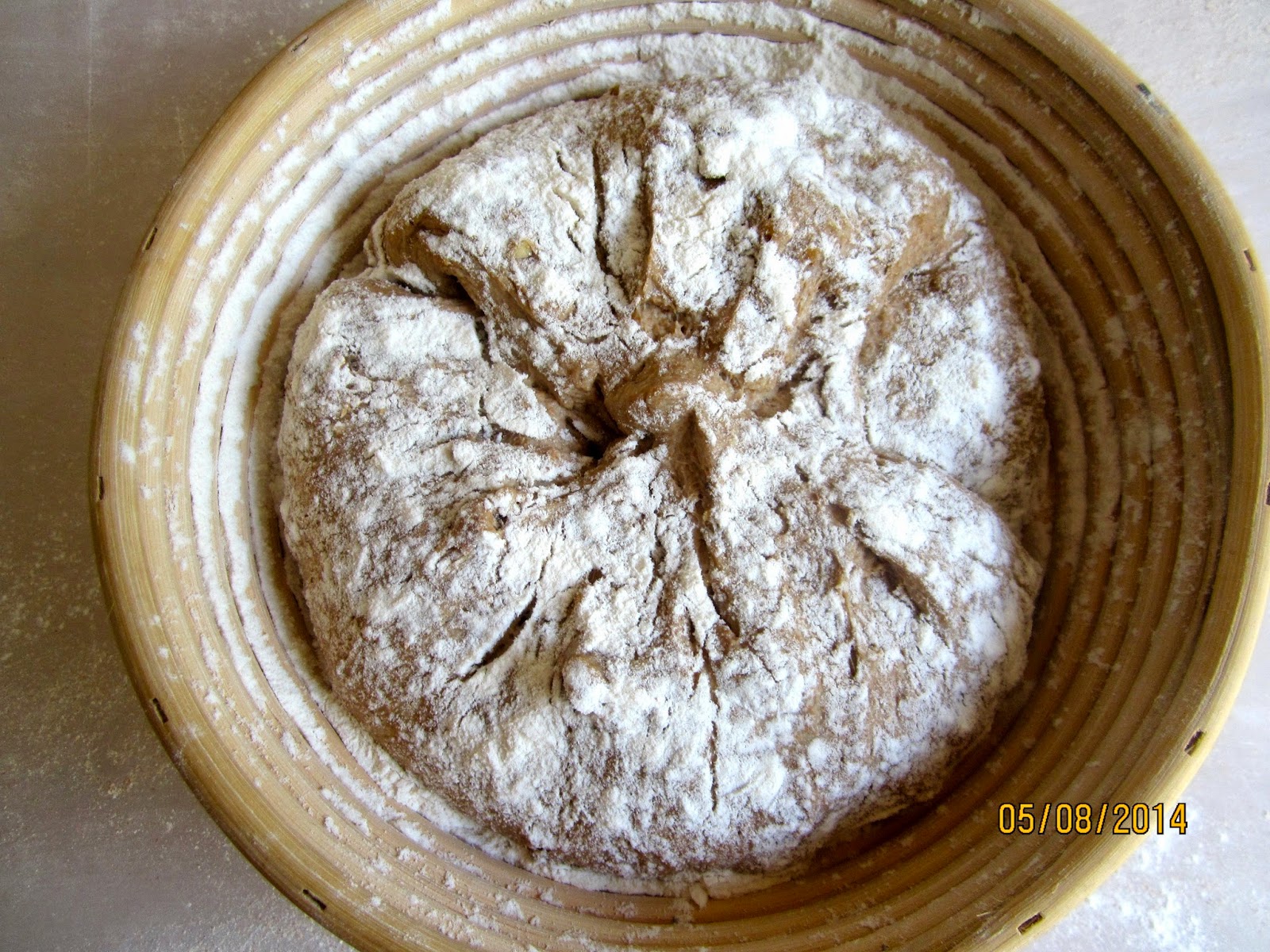
Transfer dough to lightly floured work surface, shape into a boule and place, seam side up, in a well floured rising basket. Proof for 45-60 minutes, or until it has grown 1 1/2 times its original volume  (finger poke test).

The bread has grown 1 1/2 times its original volume

Preheat oven to 425ºF/220ºC (including steam pan).

Place loaf on a parchment lined baking sheet (or bake directly on a baking stone). Score as desired.

Score before baking

Bake at 350ºF/175ºC (with steam). After 20 minutes rotate loaf 180 degrees, remove steam pan, and continue baking for another 25 minutes, until dark golden brown (internal temperature about 200ºF/93ºC).

Let cool on wire rack.

A very tasty bread!

Submitted to      Yeast Spotting
and Panissimo:  Bread & Companatico                                       
                           Sono io, Sandra


Saturday, May 3, 2014

ENGLISH DIGESTIVE BISCUITS WITH EINKORN


Hier geht's zur deutschen Version dieses Posts


Our ABC May project didn't sound too enticing to me - English Digestive Biscuits. My digestion is not something that usually comes to mind when I bake cookies.... (further comments on this subject were deleted by my in-home censor: "You Germans with your scatological humor - gross!")

But when I looked at King Arthur's recipe, I learned that these biscuits were historic cookies, first advertized in 1851 as "brown meal digestive biscuits" in London. They were even patented, claiming to be "nourishing food for people of weak digestion"!
 
Einkorn - an ancient wheat
Historic breads and pastries (or those with a connection to history) always interest me, therefore I decided to bake the biscuits - even though none of us was suffering from weak digestion (nor, for that matter, from undernourishment!)

As several reviewers recommended, I reduced the sugar (from 85 to 50 grams), exchanged the confectioners' sugar for light brown sugar, and added a bit of salt. And, since I like its nutty taste, I used Einkorn flour instead of whole wheat.

The food processor made mixing the dough a matter of a few minutes. Rolling it out was easy, too, and the dough quite forgiving, even with re-rolling the scraps several times the consistency didn't suffer.

My cookie-loving husband snatched a biscuit, soon as they came out of the oven, claiming it was a "malfatti" (misshapen), and, therefore, had to be eliminated. I insisted on a more civilized approach to consumption - the cookies were Victorian, after all! - so we had them with our afternoon tea.

The digestive biscuits were really nice, delicately crumbly, with a buttery, slightly nutty taste. The censor decreed they were MUCH better than store-bought ones ("cardboard-y"), and I felt like the perfect Victorian housewife!

Deliciously nourishing and good for you!

ENGLISH DIGESTIVE BISCUITS WITH EINKORN (adapted from King Arthur Flour)
(about 30 biscuits)

  57 g/2 oz all-purpose flour
170 g/6 oz Einkorn flour (or whole wheat)
    5 g/1 tsp. baking powder
113 g/4 oz unsalted butter, softened (1 stick)
  50 g/1.75 oz light brown sugar
 1/8 tsp. salt
 1/4 cup/60 ml cold milk

Preheat oven to 350°F/175ºC. Line 2 cookie sheets with parchment paper (or Silpat mat).

The food processor makes mixing the dough a cinch

Place flour, sugar and baking powder in bowl of food processor. Pulse to combine. Add butter and milk, and mix until dough comes together and is smooth.

Plastic foil prevents the dough from sticking to the roller pin

Transfer dough to a lightly floured work surface or silicone mat. Roll out to a bit more than 1/8"/4mm thick, and cut into desired shape. (I used a round cookie cutter with scalloped edge, 2 1/4" - 58 mm).

I used a round cookie cutter with scalloped edge

Place biscuits on prepared cookie sheets and prick evenly with a fork (they should stay flat.)

Pricking the biscuits with a fork keeps them flat

Bake until pale gold, between 15 and 20 minutes, rotating sheets 180 degrees after half the baking time for even browning (mine took 20 minutes, convection mode).

Victorian Lady - she would have loved the biscuits!

If you would like to join the Avid Bakers and take part in our monthly challenge, click here. New members are always welcome!


Monday, March 3, 2014

LITTLE BITES - MUSHROOM CHEDDAR TARTS

Hier geht's zur deutschen Version dieses Posts


Time flies, it's March, and we Avid Bakers are rising to our monthly challenge: a savory pastry from King Arthur Flour: Mushroom Cheddar Tarts. For me, a welcome change after all those holidays sweets (some sticky meringues are still uneaten!)

Like many other reviewers, I halved the recipe, since there was no big party to supply. Also, the best of all husbands left me to my fate, eating everything I bake by myself (to the detriment of my waistline), while braving a 29-hour flight and a rickety bus to visit Cambodia and Angkor Vat.

Exploring ruins instead of helping me eat - I'm left alone with my tarts!

I used my recently purchased mini-muffin pan (a bargain from HomeGoods, my home-away-from-home). Fellow bakers made regular muffin sized tarts with half the dough, but needed the whole amount of filling. For my tiny bite sized tarts half the filling was enough.

For the Hi-Maize Natural fiber in KA's recipe I used the more interesting natural fiber, contained in Einkorn flour, and Parmesan cheese instead of cheddar cheese powder. Otherwise I followed the recipe.

Don't be intimidated by a crumbly dough - it will come together
Except for one thing: "Cook's Illustrated's" secret weapon for a foolproof pie crust.

Instead of adding more (gluten enhancing) water to keep the crumbly dough from falling apart, I used Vodka!

The little tarts turned out really nice, and, left to the task of eating them alone, I "forced" myself to dine on half of the batch - a great sacrifice!

Next time (and there will be a next time!) I might try them with another vegetable, leek or tiny  broccoli florets. And perhaps some fresh herbs, too.


MUSHROOM CHEDDAR TARTS  (adapted from King Arthur Flour)
(24 mini tarts)

Crust
113 g/1 stick cold butter, cubed
120 g/1 cup all-purpose flour
34 g/1/4 cup Einkorn flour
28 g/1/4 cup Parmesan cheese, finely grated
1/4 tsp. salt
1/4 tsp. paprika
1/16 tsp. cayenne pepper
43 g/3/8 cup sharp cheddar cheese, shredded
1/4 cup ice water
1-2 tbsp. Vodka (doesn't taste, but moistens the dough without enhancing gluten formation)

Filling
57 g/1/2 cup diced mushrooms
1/2 medium red bell pepper, diced
1/2 tbsp. butter
1 egg + 1 egg yolk
3/8 cup milk or half-and-half (I used half-and-half)
1/4 tsp. salt
1/8 tsp. black pepper
1/8 tsp. dried thyme
28 g/1/4 cup sharp cheddar cheese, finely shredded

A food processor makes cutting in the butter a cinch

For the crust: combine dry ingredients in a food processor. Add butter and pulse until an unevenly crumbly mixture forms (with pea sized butter pieces.)

Vodka - secret ingredient for a foolproof pie crust

Transfer mixture to a bowl, sprinkle with cheddar and water, and, using a rubber spatula, mix and press, until dough is cohesive; add 1-2 tablespoons Vodka, if necessary (more water makes the dough less tender!)

The dough will be crumbly and have a marbled look from the butter pieces

Pat dough into a disk, wrap in plastic foil, and chill for at least 30 minutes.

For the filling: saute mushrooms and red pepper in butter until the water is evaporated and vegetables are browned. Set aside.

In a small bowl, whisk together eggs, milk, salt, pepper, and thyme. Preheat the oven to 400°F/200ºC.

Using a 2 1/2-inch cookie cutter, cut rounds

Roll dough into a 10" x 13"/25 x 33 cm rectangle, and, using a round (2 1/2"/6 cm) cookie cutter, cut 24 rounds for mini-muffin pans (re-roll dough pieces, there will not be much leftovers.)

A tamper is a great tool for fitting the rounds in the mini muffin cups

Fit rounds into cups of mini muffin pan (using a tamper helps!)

Place 1 teaspoon each of sauteed mushroom mixture and shredded cheese into each cup. Then fill with egg mixture (about 2 teaspoons).

Ready for the oven!

 Bake tarts for 18 - 22 minutes, until they are golden, and the crust browned.

Allow tarts to rest for 10 minutes before removing them from the pan.

Serve warm. (Or refrigerate and reheat for 10 minutes in a 375°F/190ºC oven.)

Great for a party buffet, or just for Sunday brunch

If you would like to participate in our monthly baking challenge, here is the link to the Avid Bakers.


Saturday, January 18, 2014

EINKORN HAZELNUT LEVAIN À LA FORKISH - PINCHED, NOT KNEADED!


Einkorn Hazelnut Levain à la Forkish
Hier geht's zur deutschen Version dieses Posts


A while ago I needed to add another book from my Amazon wish list to qualify for free shipping. More or less randomly, I picked Ken Forkish's: "Flour, Water, Salt, Yeast" - the price was right!

When I started leafing through the book, I was intrigued by his approach to kneading - or, better, not kneading the dough. From Dan Lepard's Pumpkin Whey Bread I knew that very brief kneading (30 seconds), followed by some folds, can be sufficient to process some doughs - but pinching?

Walnut Levain - my first take at Forkish's breads.
Usually I don't mix my doughs by hand (my skin is very dry) so I used a large wooden spoon for stirring flour and water together.

But Forkish is right, using your hands is much faster, and you have less cleanup afterwards.

During the pinching and folding process, the dough behaved exactly as it should: rising, then leveling out after each fold, calling for the next round.

And getting more elastic and smoother after each turn!

Forkish's descriptions are precise, and detailed, but, nevertheless, there were stumbling blocks on the way, and it took more than one trial to finally master the whole process.

Why the waste? You are supposed to build a huge amount of levain, only to use a small percentage of it for your final dough - the rest goes in the trash. Sure, flour and water don't cost much, but this is definitely not my idea of frugality and environmental consciousness!

The rationale behind this waste? Beats me. The breads taste great, even when made without all this splurging. Does a loaf, made with just as much levain as needed, taste any different from one where the starter came out of a big bucket? Hard to believe!

Sticky wicket: if you don't flour the rising basket really, really well (whether lined, or not), this can happen:

Oh, nooooo!!!

Don't think you can ease the proofed bread with your usual gentle coaxing from the basket. Forget your good manners - your dough needs slapping! After the sticky wicket of breads that stubbornly clung, and then deflated in the extraction process, I finally checked YouTube.

A bread that turned into a flounder (Overnight Brownie)

And there it was: I saw master baker Forkish slamming the banneton with gusto on the counter - brutal force did the trick! After this eye-opener I was less timid, and the breads finally let go.

Soft skin vs. hot pot. Not afraid of third degree burns, Ken Forkish places the bread smoothly into the Dutch oven. Others, with less experience, might not be so lucky. But there is an easy way out: the paper sling!

Use parchment paper for a painless transfer (Overnight White)
This worked well for other DO  breads I baked, like Aroma Bread. Therefore, save your skin - use parchment for a painless transfer.

Once these snafus were overcome, every bread I made from "Flour, Water, Salt, Yeast", plus my "à la Forkish" variations, turned out great.

"Bold baked" crust, holey crumb, and extraordinary taste - my random pick to fill my shopping cart at Amazon became one of my favorite baking books!

A&B Naturals, my favorite food store (they sell my breads!) just started carrying Einkorn flour, and I love hazelnuts. This is the formula I came up with, combining both in a loaf à la Forkish.

I include the first step - refreshing your starter to make a Forkish levain - and a time schedule.

EINKORN HAZELNUT LEVAIN

1. Step: Forkish's basic levain
12 g mature levain (your default)
48 g water (90ºF/32ºC)
48 g bread or AP flour
12 g whole wheat

 2. Step: Levain  (24 hours later)
12 g of the Forkish levain
48 g water (90ºF/32ºC)
48 g bread flour
12 g Einkorn flour

Final dough
302 g bread flour
138 g Einkorn flour
342 g water (90ºF/32ºC)
113 g hazelnuts, toasted, halved, or very coarsely chopped
11 g salt
120 g levain (all)*)

*) Following Forkish's recommendation I use a little more levain because my kitchen is usually cooler than 70ºF/21ºC (120 g instead of 108 g)

DAY 1
7:00 - 9:00 a.m. Feed your default starter to turn it into a Forkish Levain. (With this small amount the hydration of your starter doesn't matter too much, if it's between 75 and 100%.)

Lively levain

DAY 2
7:00 - 9:00 a.m. (24 hours after feeding your mature starter à la Forkish)
Refresh levain. Cover, and leave at room temperature for 7 - 9 hours.

Hydrating flours

2:00 - 4:00 p.m.
In large bowl, mix flours and water by hand, until all flour is hydrated. Cover, and let rest for 30 minutes.

Adding levain and salt

Pinching the dough...

...then folding it

Sprinkle salt over flour mixture and add levain. Prepare a bowl with water (for dipping your hands.) With (wet) hands, fold dough from sides over to the center, then, working like a pincer, pinch dough several times, alternating with folding, until dough is smooth, about 5 - 6 times. (DDT: 77º-78ºF/25º-26ºC.)

Let dough rest for 10 minutes, then incorporate nuts the same way.

Incorporating nuts (Forkish's Walnut Levain)

Fold dough three times more, twice at 20 minute intervals, the last time before going to bed. Leave, well covered, at room temperature overnight.

Dough should have tripled overnight (Forkish's Field Blend #2)
DAY 3
After 12-15 hours the dough should have tripled. Prepare a very generously floured rising basket.

Flour gives the sticky dough a "skin" underneath, so that you can fold it

Transfer dough to a floured area on an (otherwise unfloured) work surface. With floured hands, gently fold sides towards the middle to make a round. (The flour "skin" on the underside prevents sticking.)

Folding sides over to make a round

Then flip the round gently over, seam side down, onto the unfloured area. With floured hands, pull dough ball towards you, until you have a medium-tight boule.
 
Flip package over and shape into a ball (Overnight Blondie)

Place dough round, seam side down, in proofing basket, sprinkle generously with flour, cover well, and proof for about 3 - 4 hours.

Bubbly ball in banneton

3/4 hours before baking, place Dutch oven (with lid) on the middle rack, and preheat oven to 475ºF/245ºC.

Nice rise: the dough should at least double in size (Overnight Brownie)


Dimple should remain visible (Einkorn Hazelnut Levain)
The dough should at least double in size, use the finger poke test to decide whether it is ready to be baked.


Finger poke test:
Gently press a dimple with your finger in the dough - it should still be a bit elastic, but not fill up again, and stay visible. 


Place parchment paper on counter and place bread on it, smacking the banneton energetically on the counter! Cut off the 4 corners of the paper to make a sling.

Proofed bread on a parchment paper sling

Remove hot DO from oven, and put bread (with the paper) into it. Replace the lid.

Bake for 30 minutes, then remove the lid, and bake it for 20 - 25 minutes more, or until bread is medium to dark brown (internal temperature 210ºF/99ºC).

Forkish likes the "bold bake" - me too! (Overnight Blondie)

Tilt Dutch oven to slide bread out (the paper is now too brittle to serve as sling), and let loaf cool on wire rack. Let it rest for at least 20 minutes before slicing.

Einkorn Hazelnut Levain

(To illustrate the process I used photos of different Forkish breads I made, therefore colors and structure differ a bit.)

Here you can see my baker's percentage (BreadStorm users (including the free version) can download the formula here):

 
Great fun to read: Kiseger's (The Fresh Loaf) hilarious post about her take on this bread: Einkorn & Kamut.


Submitted at Yeast Spotting

Submitted at Panissimo:  Bread & Companatico                                       
                                        Indovina chi viene a cena